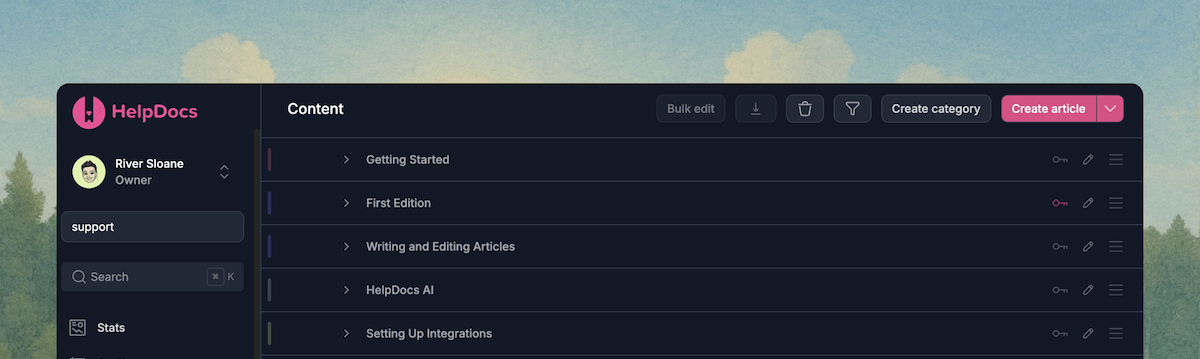
 vs
vs 
HelpDocs vs GitBook
A support-focused help center with flat pricing, compared with GitBook's Git-synced product and developer documentation.
The verdict
HelpDocs and GitBook both publish content, but they are built for different jobs. GitBook is a product and developer documentation platform with Git sync, Markdown, branching, and OpenAPI rendering, so it fits engineering teams who want docs that live next to their code. HelpDocs is a dedicated customer-facing help center built for support deflection, non-technical authors, and a Lighthouse widget that answers questions inside your app.
HelpDocs is best for
Support and content teams who want a fast, deeply customizable customer help center with flat pricing, unlimited free public viewers, and no Git workflow to learn.
GitBook is best for
Engineering and product teams who want documentation versioned in Git, edited in Markdown, and rendered alongside OpenAPI references, with branching and pull-request-style reviews.
Feature by feature
How they stack up, feature by feature
A side-by-side look at what HelpDocs and GitBook each include, grouped by the job you're trying to do.
Setup & onboarding
How quickly you can go from signup to a live, branded knowledge base.
| Feature | HelpDocs | GitBook |
|---|---|---|
| Free trial without talking to sales GitBook has a free plan for one user plus 14-day trials of Premium and Ultimate, no sales call needed. | Yes | Yes |
| Published, self-serve pricing GitBook publishes per-site plan prices. Enterprise is custom, quote-only. | Yes | Yes |
| Standalone knowledge base (no support suite required) GitBook is a standalone documentation platform, not part of a support suite. | Yes | Yes |
| Live help center the same day You can spin up and publish a GitBook site quickly, though it is styled as product docs rather than a support help center. | Yes | Yes |
| Starter templates and sample content | Yes | Yes |
| Guided migration from other tools GitBook imports Markdown, GitHub or GitLab repos, Confluence, and Notion, but the model is docs-first rather than a help-center importer. | Yes | Limited |
Authoring & editing
The day-to-day writing experience for the people who maintain your docs.
| Feature | HelpDocs | GitBook |
|---|---|---|
| WYSIWYG editor GitBook has a block-based editor that stays in sync with Markdown and Git. | Yes | Yes |
| Custom HTML blocks in articles GitBook favours Markdown, blocks, and embeds; arbitrary custom HTML in the page body is restricted. | Yes | Limited |
| Reusable snippets and content variables Reusable content and content variables are available on Premium and up. | Limited | Yes |
| Category and nested navigation management Spaces, groups, and nested pages give a clear hierarchy. | Yes | Yes |
| Version history with side-by-side diff Git-backed history plus change requests with diffs are a core GitBook strength. | Yes | Yes |
| Review and approval workflow builder Change requests, reviewers, and merge rules provide a pull-request-style approval flow. | Limited | Yes |
AI & search
How well the knowledge base answers questions and deflects tickets on its own.
| Feature | HelpDocs | GitBook |
|---|---|---|
| AI answers from your articles GitBook AI search and the AI Assistant answer from your published docs (Ultimate). | Yes | Yes |
| AI included in the base subscription The AI Assistant is gated to the Ultimate plan and capped at 500 successful answers. HelpDocs bundles AI credits into every plan. | Yes | Limited |
| AI drafting and rewriting in the editor GitBook offers AI writing assistance; deeper drafting and rewriting are less central than in HelpDocs. | Yes | Limited |
| AI style and tone enforcement HelpDocs can enforce a consistent writing style with AI on Harvest. | Yes | No |
| AI meta descriptions and SEO helpers GitBook exposes SEO settings and LLM optimizations, but meta descriptions are set manually without AI helpers. | Yes | No |
| Full-text search with failed-search reporting GitBook has full-text search, but failed-search reporting to surface content gaps is not a headline feature. | Yes | Limited |
| AI-powered semantic search HelpDocs: Ask AI draws on your monthly AI credits each time a reader uses it, so semantic search consumes the same pool as AI authoring. AI search understands natural-language queries on paid plans. | Yes | Yes |
| AI agent that resolves live conversations GitBook is a docs platform, not a chat tool. The GitBook Agent helps author docs, it does not resolve live customer conversations. | No | No |
Branding & customization
Making the help center look and feel like your own product, not a vendor template.
| Feature | HelpDocs | GitBook |
|---|---|---|
| Custom domain Custom domains are available from the Premium plan. | Yes | Yes |
| No-code color, font, and layout styling Branding controls, themes, and custom fonts (Ultimate) cover the visual basics. | Yes | Yes |
| Custom CSS GitBook styling is theme and settings based; injecting custom CSS is not generally supported. HelpDocs allows custom CSS from Sprout. | Yes | No |
| Custom JavaScript Available on HelpDocs Bloom and up. | Yes | No |
| Full HTML template control GitBook renders with its own layout; you do not control the underlying HTML templates. | Yes | No |
| Remove vendor branding (white-label) GitBook shows a 'Made with GitBook' badge on lower tiers; removing branding depends on your plan. | No | Limited |
| Multi-brand help centers You can run multiple GitBook sites, but each site is billed separately under per-site pricing. | No | Limited |
Access & permissions
Who can read and edit what, and whether the platform meets security reviews.
| Feature | HelpDocs | GitBook |
|---|---|---|
| Private or internal knowledge base Authenticated and visitor access for private docs is available on the Ultimate plan. | Yes | Yes |
| Unlimited free reader accounts HelpDocs: Anonymous readers of a public help center are unlimited and free. Gated or authenticated readers can cost extra. Public GitBook sites have unlimited readers. Paid plans charge per editor or authenticated user, not per public reader. | Yes | Yes |
| Content-level permission groups Roles plus sections and authenticated access give some control; granular content-level permission groups are not the focus. | Yes | Limited |
| SSO and SAML SAML SSO is Enterprise-only on GitBook. HelpDocs includes SSO on Harvest. | Yes | Limited |
| SCIM user provisioning HelpDocs: HelpDocs has limited SCIM provisioning, alongside SAML, OIDC, and JWT SSO. Automated user provisioning is reserved for GitBook Enterprise; HelpDocs SCIM support is limited. | Limited | Limited |
| Audit trail Audit logging is an Enterprise feature. HelpDocs adds an audit trail on Bloom and up. | Yes | Limited |
Analytics
Understanding what readers search for, what works, and where content is failing.
| Feature | HelpDocs | GitBook |
|---|---|---|
| Article views and engagement GitBook reports page views and traffic analytics. | Yes | Yes |
| Search and failed-search reporting Search analytics exist, but failed-search reporting is not surfaced the way a support help center needs. | Yes | Limited |
| AI answer and deflection analytics GitBook AI Insights (Ultimate) report on AI answers; HelpDocs reports Ask AI and ticket deflection. | Yes | Limited |
| Reader feedback and ratings User feedback collection is available from the Premium plan. | Yes | Yes |
| Contributor and team performance reports GitBook centers on Git activity and change requests rather than a contributor performance leaderboard. | Yes | Limited |
| Reporting data export | Yes | Limited |
Integrations & API
How the knowledge base plugs into the rest of your stack, and whether it doubles as a support suite or developer docs.
| Feature | HelpDocs | GitBook |
|---|---|---|
| Public REST API and webhooks HelpDocs: HelpDocs has a read/write REST API, plus Slack webhooks for publish, feedback, and team events. It does not have general-purpose outbound webhooks. GitBook has a public API, webhooks, and an integrations marketplace. | Limited | Yes |
| Integrations Slack and Zapier are available through GitBook integrations. | Yes | Yes |
| Help desk integrations (Intercom, Zendesk) GitBook connects to some tools, but native help-desk integrations are not its focus. HelpDocs is built to sit next to your help desk. | Yes | Limited |
| Embeddable in-app help widget GitBook has no in-app help widget. HelpDocs ships the Lighthouse widget to answer questions inside your product. | Yes | No |
| Built-in live chat and messenger Neither tool is a live-chat platform. HelpDocs integrates with chat tools rather than replacing them. | No | No |
| Built-in ticketing and shared inbox | No | No |
| OpenAPI and Swagger reference rendering OpenAPI import with auto-updated, interactive API references is a core GitBook strength. | No | Yes |
Pricing
Pricing, side by side
Pricing below is accurate as of July 2026. HelpDocs is a flat monthly subscription for a set number of editors, with unlimited free public viewers and AI credits included. GitBook bills per documentation site, with additional team members charged per user on top, so the real cost depends on how many sites and editors you run.
Sprout
$99/mo billed annually. 5 editors, 1,000 AI credits/mo, AI meta features, unlimited free public viewers, custom CSS.
Bloom
$239/mo billed annually. 15 editors, 5,000 AI credits/mo, AI drafts, rewrites, Ask AI, and AI style enforcement, audit trail, 20 languages, Lighthouse widget, custom JS and HTML templating.
Harvest
$399/mo billed annually. 25 editors, 10,000 AI credits/mo, unlimited languages, permissioning, SSO. Extra editors on Harvest are $25 each per month.
Free
One user. Block editor, GitHub and GitLab sync, API playgrounds, page-view analytics, and full-text search.
Premium
Billed annually, plus $12/user/mo. Adds AI search, custom domain, advanced branding, feedback, redirects, and reusable content.
Ultimate
Billed annually, plus $12/user/mo. Adds the AI Assistant (500 successful answers), AI Insights, authenticated access, and custom fonts.
Enterprise
Quote-only. Adds SAML SSO, audit logs, white-glove migration, custom integrations, and a dedicated account manager.
The bottom line: As of July 2026, GitBook's per-site model looks cheap at the base price but climbs as you add editors ($12/user/mo) and extra sites, and its full AI features only unlock on Ultimate at $249/site/mo. HelpDocs Bloom covers up to 15 editors for a flat $299/mo ($239 annually) with unlimited viewers and AI credits included on every plan. If you want a customer help center with predictable pricing and AI from the start, HelpDocs is simpler to budget. If you want Git-synced developer docs and are happy to pay per site and per user, GitBook's model fits that workflow.
Switching
Switching from GitBook
GitBook stores content as Markdown, so your docs are portable. You can export your GitBook pages, then bring the Markdown and images into HelpDocs, where you rebuild categories and navigation for a support audience. The bigger shift is conceptual rather than technical: you are moving from Git-based, developer-owned docs to a help center that non-technical authors can update directly in the HelpDocs editor, with a WYSIWYG workflow instead of branches and pull requests. Plan to review formatting and restructure content around customer questions as you go.
- 1 Export your GitBook content as Markdown (or pull it from your synced GitHub or GitLab repo).
- 2 Create your HelpDocs help center and import the Markdown and images.
- 3 Rebuild categories and navigation around the questions your customers actually ask.
- 4 Recreate any OpenAPI or code-heavy pages, keeping developer references in GitBook if you still need them.
- 5 Point your custom domain at HelpDocs and add the Lighthouse widget to your app.
Honest trade-offs
Why teams pick one over the other
Why teams choose HelpDocs
- Purpose-built customer help center focused on support deflection, not developer docs.
- Flat, predictable pricing from $129/mo with unlimited free public viewers, no per-user or per-site add-ons.
- AI credits bundled into every plan, with drafts, rewrites, and Ask AI, not gated behind a top tier.
- Deep customization: full CSS from Sprout, custom JavaScript, and HTML templating on Bloom and up.
- The Lighthouse widget answers questions and deflects tickets right inside your product.
- Built for non-technical authors: no Git, branches, or Markdown syntax required to publish.
- Failed-search reporting and deflection analytics that show exactly where content is missing.
- Multilingual help in 100+ languages, with unlimited languages on Harvest.
Why teams choose GitBook
- Git sync with GitHub and GitLab keeps docs versioned alongside your codebase.
- Markdown-first editing that developers already know and can review in pull requests.
- OpenAPI and Swagger import with auto-updated, interactive API reference rendering.
- Branching and change requests map release versions to Git branches.
- Strong fit for product and developer documentation that lives next to code.
- Per-site pricing can be cheap for a small, docs-focused team with few editors.
- API playgrounds and preview deployments built for technical audiences.
FAQ
Questions about HelpDocs vs GitBook
What is the difference between HelpDocs and GitBook?
Is HelpDocs cheaper than GitBook?
Can I migrate my GitBook docs to HelpDocs?
Does HelpDocs render OpenAPI or Swagger API references?
Do I need to know Git or Markdown to use HelpDocs?
Which tool is better for a customer help center?
Is HelpDocs a good GitBook alternative?
Ready to switch to HelpDocs?
Start free 14-day trialCreate, organize, translate, and connect your docs without the admin sprawl of a support suite.
No credit card required.