Knowledge Base Template
A knowledge base template gives you a ready-made structure for the whole thing, not just one article. Use this free knowledge base template to lay out your top-level categories, decide which article types to include, standardize how every article is written, and launch with a plan for who keeps it current. Copy the structure and start filling it in today.
 Open in Claude
 Open in ChatGPT
I need to write a Knowledge Base. Act as an expert technical writer and draft one for me.

Use this structure, keeping each section clear, concise, and genuinely useful to the reader:

1. Top-level categories
2. Category structure
3. Article types to include
4. Standard article template
5. Naming and style conventions
6. Launch checklist
7. Ownership and review cadence

Before you begin, ask me for the details you need: the product, team, or audience this is for, and anything specific I should include. Then write the full Knowledge Base in clean, well-formatted Markdown.
Write a Knowledge Base using the structure below. Keep each section clear, concise, and genuinely useful to the reader.

Structure:
1. Top-level categories
2. Category structure
3. Article types to include
4. Standard article template
5. Naming and style conventions
6. Launch checklist
7. Ownership and review cadence

Use rich formatting so it reads well in a knowledge base:
- Clear headings and subheadings for each section.
- Callout boxes for asides: a Tip callout for advice, a Note callout for helpful context, and an Important callout for anything a reader must not miss.
- Tables for structured or comparison content.
- Numbered lists for sequential steps and bulleted lists for options.
- Bold for key terms and any values people must not get wrong.
## The knowledge base template

### 1. Top-level categories

Decide the handful of categories every article will live under. Name them the way customers describe their goals, not the way your teams are organized. A common starting set:

| Category | What lives here | Owner |
| --- | --- | --- |
| Getting started | Setup, first-run, key concepts | TODO |
| Using [product] | Core how-to guides for everyday tasks | TODO |
| Troubleshooting | Fixes for common errors and issues | TODO |
| Billing and account | Plans, invoices, account management | TODO |
| Integrations | Connecting other tools | TODO |
| FAQ | Quick answers to recurring questions | TODO |

Keep the list to roughly five to eight categories. Add subcategories only when one genuinely outgrows a single page.

### 2. Category structure

For each category, note its purpose in one line, who owns it, and which article types belong in it. This stops the same topic being filed in three places and gives every category a person accountable for its shape.

### 3. Article types to include

Different jobs need different articles. Standardizing the type makes the whole help center scannable:

- **Getting-started guide:** orients a brand-new user end to end.
- **How-to guide:** one task, numbered steps, a clear outcome.
- **Reference / documentation:** the full detail on a feature or setting.
- **Troubleshooting article:** symptom, cause, fix.
- **FAQ entry:** a short answer that links to the fuller article.

### 4. Standard article template

Every article, whatever its type, should share a skeleton so readers always know where to look:

1. **Title.** Plain and searchable, phrased the way people ask.
2. **Summary.** One or two lines on what the article covers and who it is for.
3. **Body.** Steps, reference, or explanation, with screenshots where they save words.
4. **Related links.** Point to the next logical article and the parent category.
5. **Owner and last-updated.** So readers and editors can trust it is current.

### 5. Naming and style conventions

Agree the small rules that keep 200 articles feeling like one voice: title casing, how you phrase headings (task-first, "Reset your password" not "Password resets"), terminology to standardize, screenshot style, and how you tag and slug articles. Write these down so new authors inherit them.

### 6. Launch checklist

Before you make the knowledge base public, confirm the basics are in place:

- Categories created and ordered the way customers scan.
- At least a few solid articles seeded in each category (no empty shelves).
- Search enabled and returning sensible results.
- Navigation and titles readable by someone who has never seen the product.
- Every launch article has an owner and a review date.

### 7. Ownership and review cadence

Assign an owner per category and a review date per article, and set a recurring check on the structure itself. Structure drifts the moment nobody is accountable for it, so make maintenance a routine rather than a rescue mission.

| Area | Owner | Review cadence | Next review |
| --- | --- | --- | --- |
| Category structure | TODO | Quarterly | TODO |
| Getting started | TODO | Monthly | TODO |
| Troubleshooting | TODO | Monthly | TODO |
The knowledge base template
This template is meta: it lays out the structure of a whole knowledge base, not a single article. Copy the sections below into a planning doc, agree on them with your team, then build the categories and article template inside your knowledge base editor.
1. Top-level categories
Decide the handful of categories every article will live under. Name them the way customers describe their goals, not the way your teams are organized. A common starting set:
| Category | What lives here | Owner |
|---|---|---|
| Getting started | Setup, first-run, key concepts | TODO |
| Using [product] | Core how-to guides for everyday tasks | TODO |
| Troubleshooting | Fixes for common errors and issues | TODO |
| Billing and account | Plans, invoices, account management | TODO |
| Integrations | Connecting other tools | TODO |
| FAQ | Quick answers to recurring questions | TODO |
Keep the list to roughly five to eight categories. Add subcategories only when one genuinely outgrows a single page.
2. Category structure
For each category, note its purpose in one line, who owns it, and which article types belong in it. This stops the same topic being filed in three places and gives every category a person accountable for its shape.
3. Article types to include
Different jobs need different articles. Standardizing the type makes the whole help center scannable:
- Getting-started guide: orients a brand-new user end to end.
- How-to guide: one task, numbered steps, a clear outcome.
- Reference / documentation: the full detail on a feature or setting.
- Troubleshooting article: symptom, cause, fix.
- FAQ entry: a short answer that links to the fuller article.
4. Standard article template
Every article, whatever its type, should share a skeleton so readers always know where to look:
- Title. Plain and searchable, phrased the way people ask.
- Summary. One or two lines on what the article covers and who it is for.
- Body. Steps, reference, or explanation, with screenshots where they save words.
- Related links. Point to the next logical article and the parent category.
- Owner and last-updated. So readers and editors can trust it is current.
5. Naming and style conventions
Agree the small rules that keep 200 articles feeling like one voice: title casing, how you phrase headings (task-first, “Reset your password” not “Password resets”), terminology to standardize, screenshot style, and how you tag and slug articles. Write these down so new authors inherit them.
6. Launch checklist
Before you make the knowledge base public, confirm the basics are in place:
- Categories created and ordered the way customers scan.
- At least a few solid articles seeded in each category (no empty shelves).
- Search enabled and returning sensible results.
- Navigation and titles readable by someone who has never seen the product.
- Every launch article has an owner and a review date.
7. Ownership and review cadence
Assign an owner per category and a review date per article, and set a recurring check on the structure itself. Structure drifts the moment nobody is accountable for it, so make maintenance a routine rather than a rescue mission.
| Area | Owner | Review cadence | Next review |
|---|---|---|---|
| Category structure | TODO | Quarterly | TODO |
| Getting started | TODO | Monthly | TODO |
| Troubleshooting | TODO | Monthly | TODO |
How to fill in this knowledge base template
A structure only pays off if the articles inside it are genuinely findable. A few habits make the difference:
- Organize around customer goals. Categories named after what people are trying to do beat categories named after your internal teams.
- Keep the tree shallow. Nothing should sit more than two or three clicks from the homepage. Lean on search and clear titles instead of deep folders.
- Seed every category. Empty categories signal an abandoned help center. Publish a few strong articles per category before you launch.
- Standardize one article layout. When every article shares a skeleton, readers stop hunting and start scanning.
- Give it owners and review dates. A knowledge base with no owners quietly rots. Naming them keeps it current as the product changes.
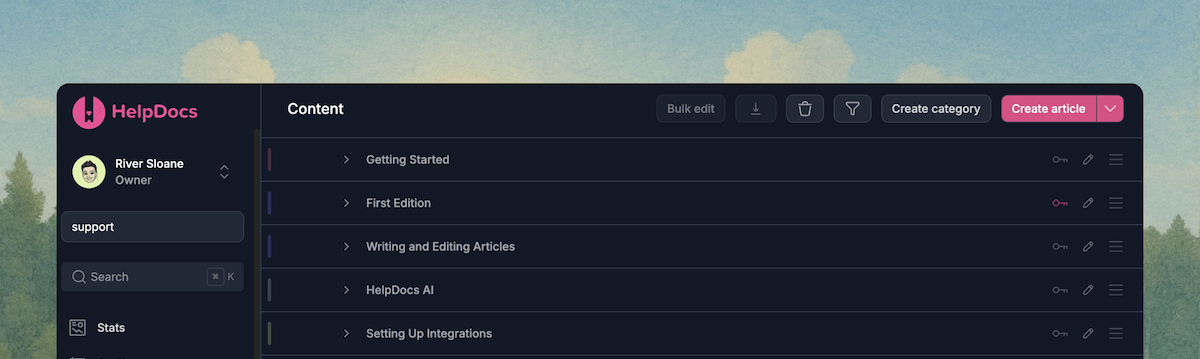
For help wiring your categories and articles together as the library grows, see how HelpDocs lets you create and organize content.