Best Intercom Alternatives (2026)
Most teams don't leave Intercom because Fin doesn't work. They leave because the bill moves in two directions at once, per seat and per resolution, so a good month of deflection arrives as a bigger invoice. Here's what's actually worth switching to, and which half of Intercom you probably need to replace.
We built HelpDocs because we kept running into teams who were jumping around customer support platforms and constantly fighting to migrate their knowledge base. So we built one that does one thing really well: being a wonderful knowledge base, not a bundled suite. No yearly migrations, just good self-serve support. We've tried to be honest about what each alternative actually does well, including the parts of Intercom nothing here replaces.
Intercom is $29 per seat per month on Essential, $85 on Advanced and $132 on Expert, and then We integrate with FinFin bills separately at $0.99 for every resolution, with a 50-resolution monthly minimum. So there are two dials on your invoice and you only control one of them.

Hire two people and it goes up. Have a busy month and it goes up. Have a brilliant month where Fin deflects everything, and it goes up then too.
That last one is the version of the problem most people searching for an We integrate with IntercomIntercom alternative are carrying. The pricing isn’t outrageous, it’s just unforecastable, and finance has started asking why the support line item moves 30 percent between quarters. Success and cost point the same direction, which is a strange thing to sign up for.
To be fair to Intercom, it earns that money for the teams it was built for. Fin is the most complete AI-agent-first support product you can buy today, and it isn’t close. If your plan is an AI agent handling the front line end to end rather than customers reading docs and going away satisfied, nothing else on this page is really attempting the same thing. And the Messenger, Articles and Fin genuinely behave as one system rather than three products with integrations bolted between them, which is rarer than vendors make it sound.
But that’s not most people reading this. So to be clear about scope: this page is about replacing Intercom Articles, the help center half, rather than the Messenger or Fin. If what you actually need is a great knowledge base, and the chat widget was always somebody else’s decision, here’s how the alternatives stack up.
What actually matters when you’re leaving Intercom
Feature lists are mostly noise at this stage, because every tool here can store an article and put a search box on top of it. Three things genuinely separate one piece of knowledge base software from another, and for people leaving Intercom they’re a slightly different three than usual.
The first is the shape of the bill, not the size of it. Per seat, per resolution, per project, or flat changes what happens when you hire, when traffic spikes, or when deflection finally works. If unpredictability is what drove you here, check that the alternative isn’t quietly metered too. Two of the six on this list still are.
The second is whether the help center is a product or a feedstock. In Intercom, Articles increasingly exists to feed Fin, and that’s a coherent strategy rather than neglect, but it shows up in the tooling. If you want proper category management, versioning, failed-search reporting and real theming, you want a vendor whose whole roadmap points at the help center.
The third is what you’re willing to give up. Nothing on this list resolves live conversations the way Fin does. Some of these tools give you an inbox instead, some give you nothing but docs and expect you to keep Intercom for chat. Knowing which trade you’re making is most of the decision.
Everything below is as of July 2026, taken from each vendor’s own pricing page.
The shortlist at a glance
We build HelpDocs, so we’ve put ourselves first rather than pretending to be neutral about it. What we’ve also done is say plainly who each of the other five is genuinely better for, because matching the wrong tool to your situation wastes a lot more of your money than picking the wrong vendor from a list.
All six replace Intercom Articles. Only two of them replace the Messenger and inbox as well, and none of them replaces Fin. If you’re earlier in the process, our learning resources cover how to structure a help center before you pick one.
| Tool | Best for | Starting price | Pricing model | Free trial |
|---|---|---|---|---|
| HelpDocs | A standalone knowledge base, without paying for a support suite | $129/mo | Flat monthly, per editor, readers free | 14-day trial |
| Help Scout | Teams who want to replace Intercom’s inbox and chat too, more simply | $25/user/mo | Per user, plus $0.75 per AI resolution | Free plan and a trial |
| Document360 | Versioned, audited documentation and rendered API references | Quote only | Per project, quote only | 14-day trial |
| Helpjuice | Bespoke theming across several languages, done for you | $249/mo | Flat monthly, capped by logins | 14 days, no card |
| Notion | Early-stage teams who already write everything in Notion | $0 | Per seat, free plan available | Free plan |
| Zendesk | Large support orgs that need deep omnichannel ticketing | $55/agent/mo | Per agent, plus AI add-ons and metered resolutions | 14-day trial |
Best for a standalone knowledge base without the support suite: HelpDocs
We make HelpDocs (hey! 👋), so we might be a little biased. But we’ve tried to be as honest as possible to make things easier for you, and you can check anything that matters against the pricing page. Here’s the honest positioning: HelpDocs is for teams who want a standalone, best-in-class knowledge base, without paying for a bloated support suite.
That’s the whole design. Every other tool in this list is either a support suite with docs attached, or a documentation platform with different priorities. When the knowledge base is the product rather than the thing feeding an AI agent, the attention lands in different places.
You can be live and branded in hours on the professional templates rather than scheduling onboarding. Branding runs from no-code colors and fonts all the way through to custom CSS, JavaScript and full HTML template control, so you stop at the point you choose rather than the point the vendor chose. The V5 templates score 100/100 for SEO and accessibility in PageSpeed, which matters because a help center that ranks is a help center that deflects before anyone opens a chat window.
Two more things worth naming for anyone coming from Fin. AI here is per-feature and metered in credits that are already in your plan, so you can turn on Ask AI and AI authoring where they earn their place and leave them off where they don’t, rather than paying per outcome. And multilingual is built in rather than bolted on: 100+ languages with bulk machine translation across your whole library, 20 languages on Bloom and unlimited on Harvest.
On pricing, it’s flat and published, from $129/mo. It doesn’t move when your support team hires, and public readers are free and unlimited forever, so the outcome you actually want, more people finding answers themselves, never arrives as a bigger invoice. There’s also a read/write REST API, so your content stays reachable and portable rather than trapped.
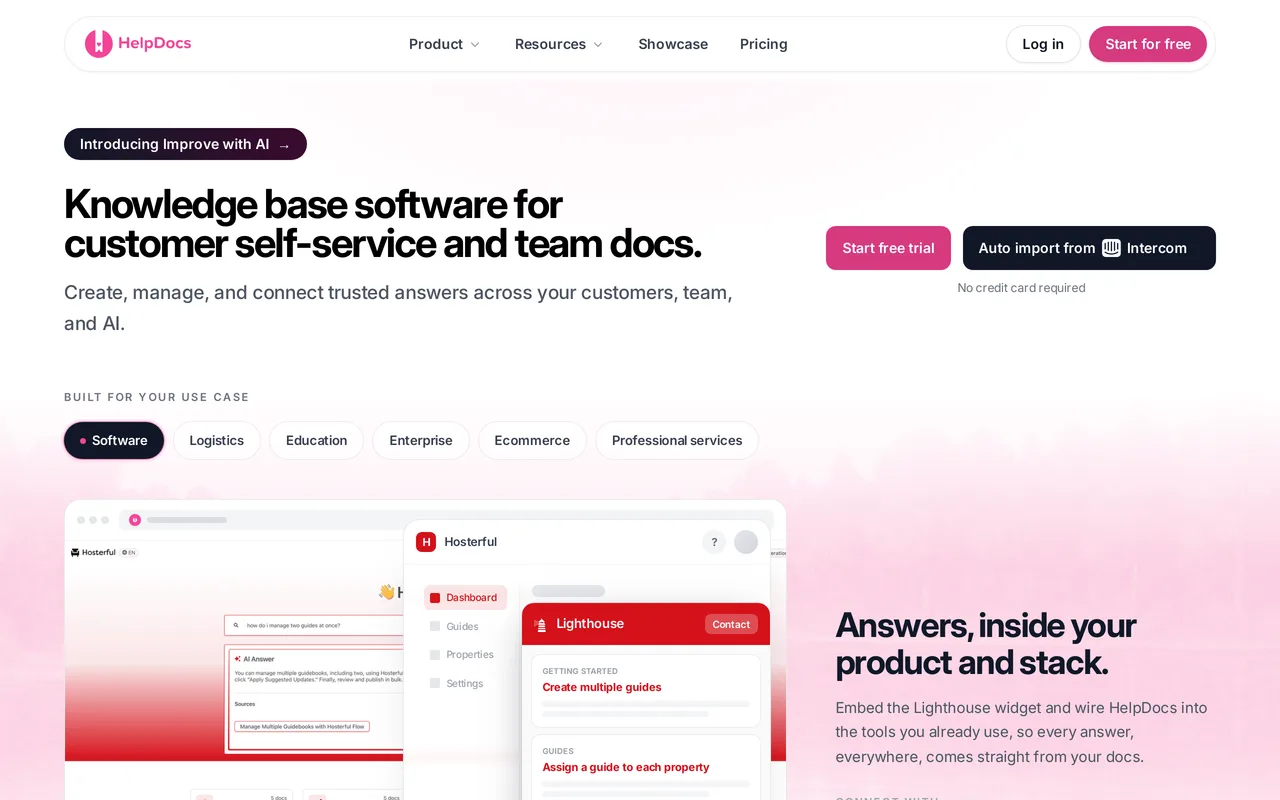
The catch: we don’t do the thing Intercom is best at. No Messenger, no shared inbox, no AI agent resolving live conversations, and we’re not building one. If Fin is load-bearing for you then HelpDocs is a component in your stack, not a replacement for it, and you’ll be running both. Intercom also does multi-brand Help Centers on Expert and we don’t do that at all, there’s no free tier here, only a 14-day trial, and limited SCIM provisioning, which is occasionally a hard no from an IT team. HelpDocs vs Intercom sets out where Intercom is genuinely the better buy.
Best for teams who want a standalone knowledge base, not a support suite. Flat $129/mo, readers free. Start a free trial or see pricing.
Best for replacing Intercom’s inbox with something simpler: Help Scout
If you need the chat and the inbox as well as the docs, Help Scout is the obvious place to start. It does most of what Intercom does, shared inbox, email, the Beacon widget for chat and search, and a knowledge base called Docs, with a fraction of the administrative surface area. Teams who move there tend to describe it as relief. You can set the whole thing up in a morning without reading documentation about how to read documentation.
It’s the most honest “replace most of Intercom” answer available at a small-team price. Go in knowing which half of the product is the strong one: the inbox is excellent, and the knowledge base is capable but deliberately plain.
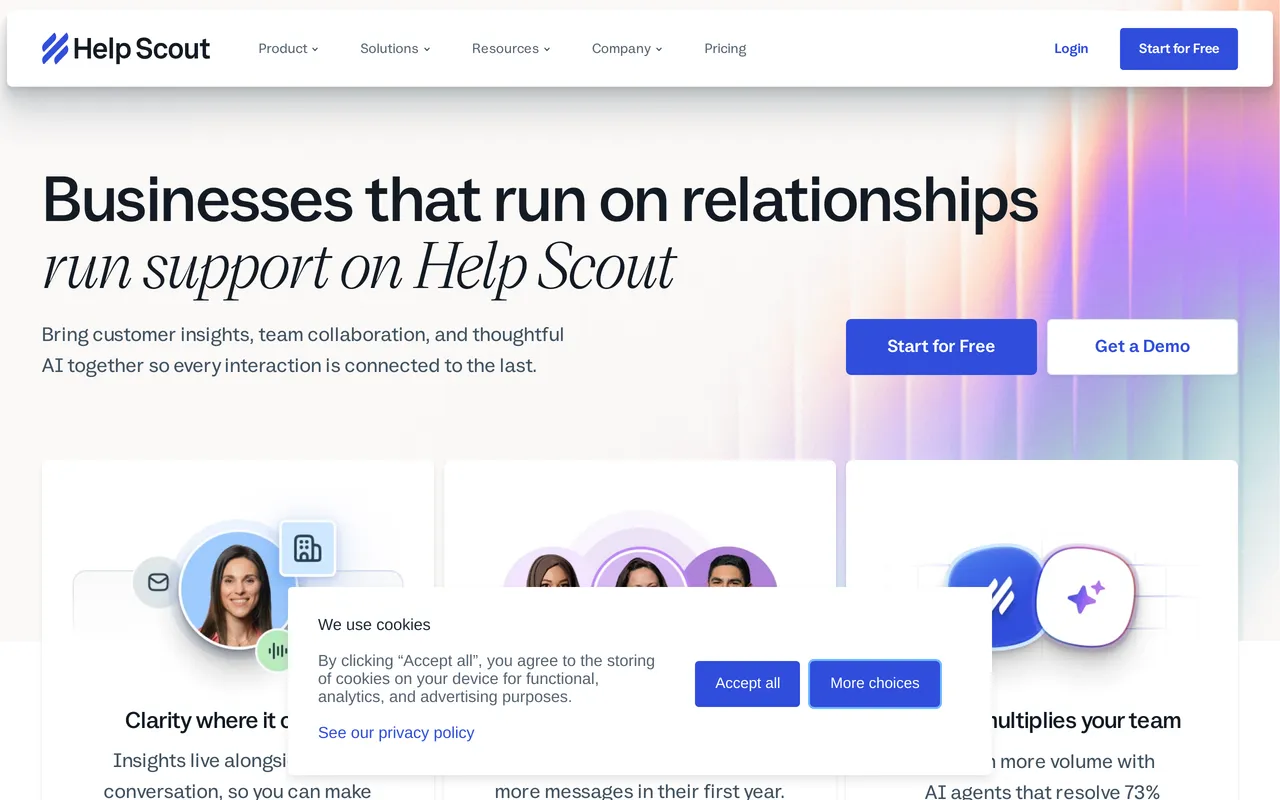
The catch: you haven’t escaped the two-dial bill, you’ve just made both dials smaller. It’s still per user, and AI Answers is still metered on top at $0.75 per resolution rather than included. Docs is also the junior partner: theming, content structure, and the tooling for managing several hundred articles all sit behind anything built purely for help centers. See the full HelpDocs vs Help Scout breakdown.
Best for teams who want one simpler vendor for conversations and docs. From $25/user/mo.
Best for versioned, audited documentation: Document360
Document360 is the tool on this list that treats documentation as an engineering artifact. Its version history and diff tooling is built for audit-heavy documentation, where somebody has to prove who changed which sentence and when. There’s a workflow builder that can hold an article until the right person has approved it, separate workspaces so each product gets its own docs site, and native rendering of OpenAPI references, so your API reference and your written guides sit in one place instead of two. If your docs get audited, or a legal team has an opinion about what your release notes said in March, that’s the reader it was designed for.
It’s also the least help-center-ish of the specialists, which is the trade. You’d choose it because your documentation has compliance attached, not because you want something a support team will enjoy maintaining day to day.
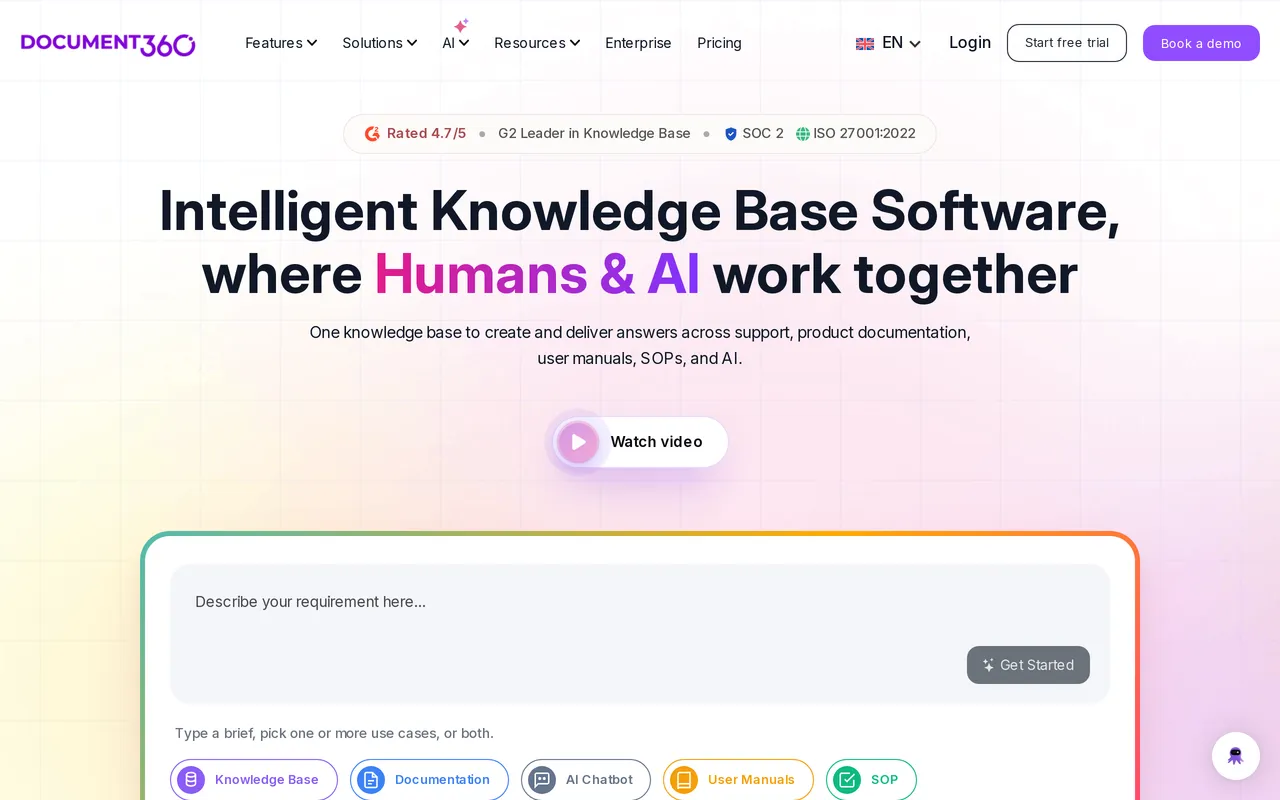
The catch: you can’t find out what it costs. Pricing is quote-only and charged per project, so evaluating it means a sales conversation before you see a number, and another one if you later want a second docs site. Its Ask Eddy AI is a paid add-on on top of the base subscription, which lands awkwardly if metered AI is part of why you’re leaving Intercom in the first place. See the full HelpDocs vs Document360 breakdown.
Best for regulated, heavily versioned docs and API references. Quote only, per project.
Best for heavily branded, multilingual help centers: Helpjuice
Theming is Helpjuice’s whole pitch, and it goes right down to the templates. You get the theme files, plural: HTML, CSS, JavaScript and Liquid templates, editable per language, with a visual editor for people who want none of that. On top of that their team will hand-skin your help center as part of signing up, and they’ll run the import as a service with free migration hours, redirects and re-uploaded images included. If you want the finished result without doing the work yourself, that’s a real offer, and worth pricing against what a designer and a migration week would cost you.
Localization and AI article translation are on every tier including the cheapest, which is genuinely unusual, since multilingual is normally the lever vendors pull to move you up a plan.
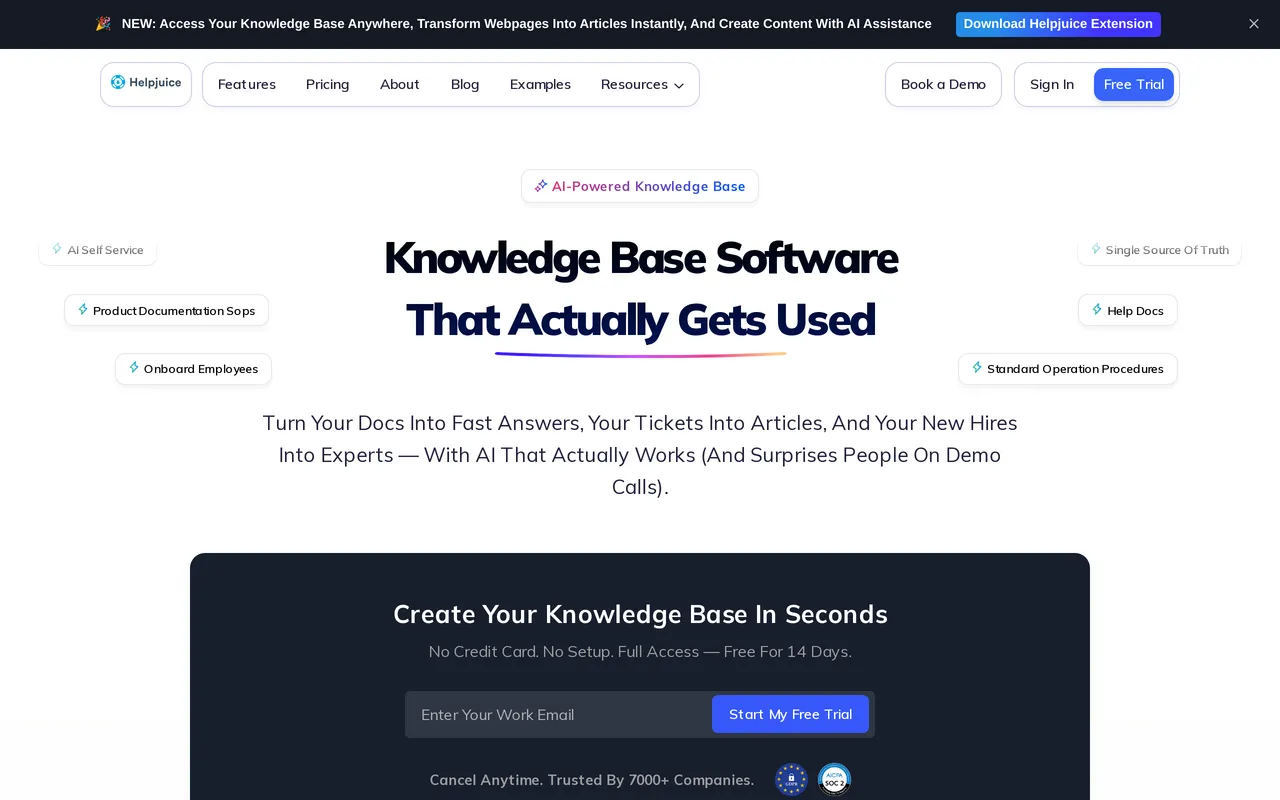
The catch: the entry plan is built for a smaller team that wants the theming rather than the AI, so work out which tier you need before you compare headline prices. $249/mo covers 30 logins with no SSO and no AI features, AI search and the chatbot start at $449/mo, roughly an 80 percent step up, and unlimited logins is $799/mo. Only monthly pricing is published, with no annual discount shown anywhere, and there’s a 14-day trial with no card but no free tier to sit on afterwards.
Best for brand-heavy, multilingual help centers with a done-for-you migration. From $249/mo flat.
Best for startups already writing everything in Notion: Notion
If your team already writes everything in Notion, publishing what’s already there costs nothing and takes an afternoon, and for a ten-person company that’s very often the correct call. It’s a lovely writing tool, the free plan is real rather than a trap, and there’s no migration project because there’s nothing to migrate. Plenty of good companies ran their docs this way for their first two years, and there’s no prize for buying a help center platform before you can feel the limits of the one you have.
Be clear-eyed about what you’re shipping, though. You’re publishing a wiki page customers can read, which is a different product from a help center.
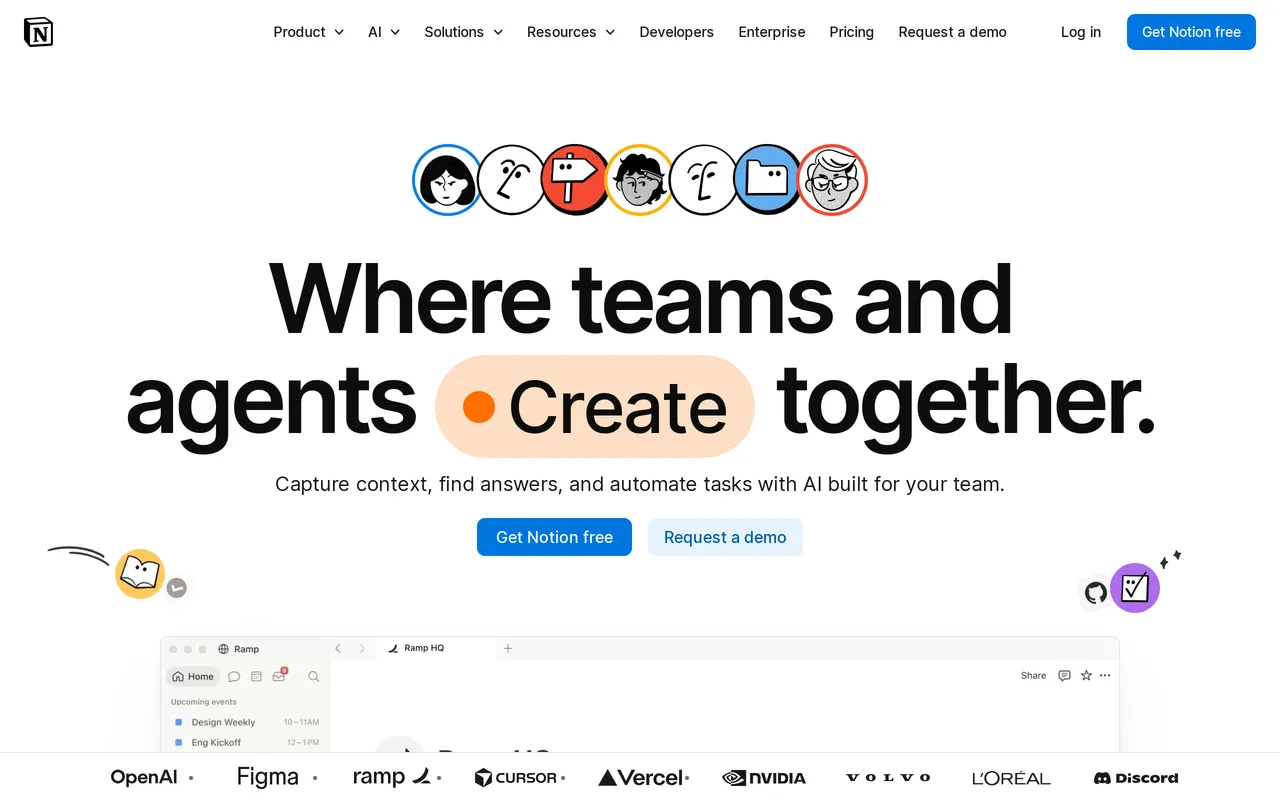
The catch: search is the weakest of anything here, and search is how people actually use a help center, so the deflection you were hoping for mostly won’t arrive. Publishing to your own domain is a paid Notion Sites add-on, full Notion AI only lands on Business at $20/seat/mo, and you get none of the operational feedback loop: no failed-search reporting, no article ratings, no deflection analytics. You won’t know what’s not working. See the full HelpDocs vs Notion breakdown.
Best for early-stage teams already living in Notion. Free, paid tiers from $10/seat/mo.
Best for large omnichannel support operations: Zendesk
Zendesk is the other direction you can go from Intercom, and for a certain kind of team it’s the right one. If you’re running a real support operation, dozens of agents, SLAs that matter, routing rules, phone, side conversations and a QA process, there’s very little that does all of that as thoroughly. Its ticketing is deeper than Intercom’s, its Explore reporting covers the whole operation rather than the knowledge base, and Curlybars theming gives you genuine HTML template control over the help center, which is more than most suites offer.
Teams usually move Intercom to Zendesk when they’ve grown into process rather than out of it. It’s a scale answer, not a cost answer.
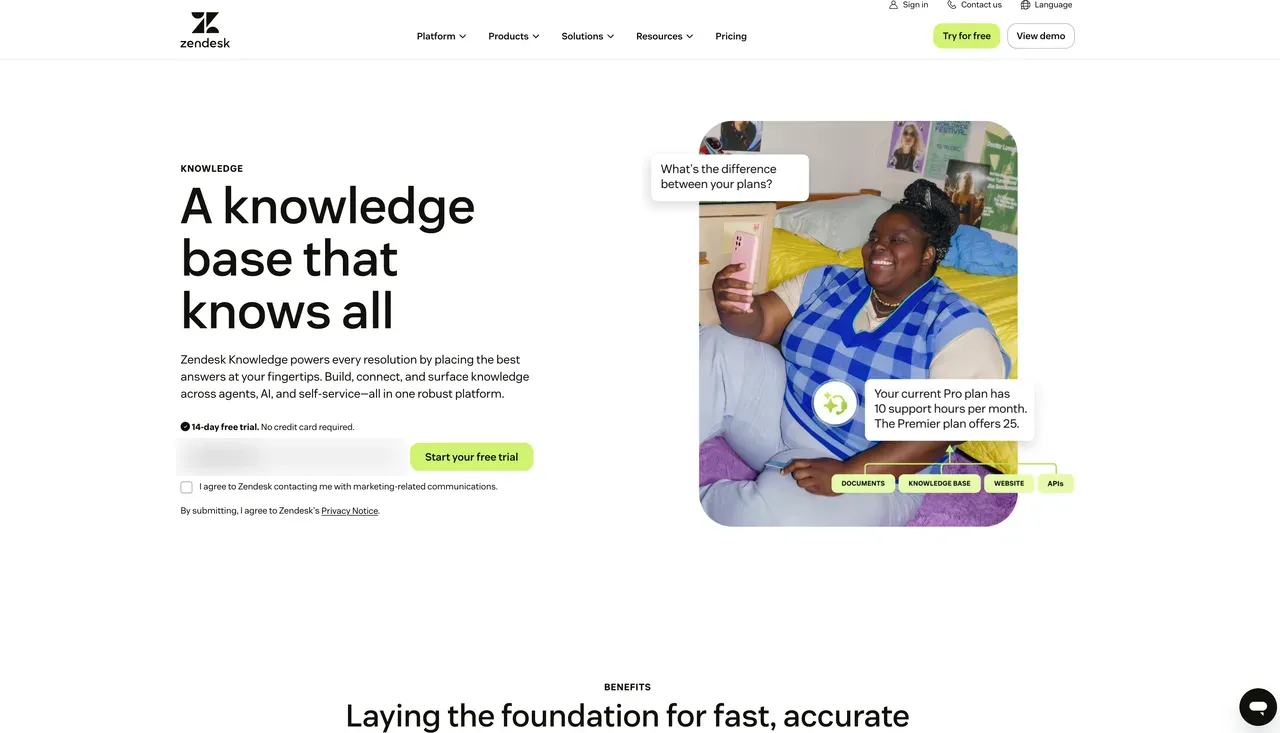
The catch: it’s the most expensive way to solve this and it doesn’t fix the thing you came here about. Suite Team is $55 per agent per month rising to $115 on Professional, the Advanced AI (Copilot) add-on is roughly another $50 per agent per month, and automated AI resolutions are metered once you pass a small free allowance. That’s the same two-dial invoice you already have, with bigger numbers on both dials. Zendesk Knowledge, formerly Guide, is also a bundled module rather than a product in its own right, so if Articles felt like an afterthought, Guide will feel familiar. See the full HelpDocs vs Zendesk breakdown.
Best for large omnichannel support orgs that need deep ticketing. From $55/agent/mo.
Top Intercom competitors, grouped by what they replace
If you’re still orienting yourself, the Intercom competitors worth your time fall into three groups, and picking the wrong group is how people end up on their third demo call of the week. HelpDocs vs Intercom is the head-to-head if you’ve already narrowed it to us.
There are the full suite replacements, Help Scout and Zendesk, which take on conversations, chat and docs together. Both carry the same structural cost as Intercom, in that you pay per person and meter the AI, so read their AI pricing as carefully as you read Fin’s.
Then there are the knowledge base specialists, HelpDocs, Document360 and Helpjuice, which do the help center and nothing else. This is where teams land when Articles felt underpowered but the Messenger is still doing its job.
And there are the general-purpose tools pressed into service, Notion and Confluence. Cheapest by a distance, and least like a help center by a similar distance.
If you only need to replace Intercom Articles
This is the most common version of the question and it changes the answer completely, so it’s worth being explicit.
Articles isn’t sold separately. It arrives with a seat plan, which means every person you’re paying for includes a help center whether they ever open the editor or not, and Fin sits on top of it either way. A lot of teams are perfectly happy with Intercom for conversations and only frustrated by the docs, and if that’s you then a full migration is the wrong project.
Keep the Messenger for chat, move the articles somewhere that cares about them, and point your help center domain at the new one. HelpDocs, Document360 and Helpjuice all support that split, and HelpDocs maintains an official Intercom Messenger app precisely so article search keeps working inside the chat your customers already use.
One thing to plan for that’s specific to Intercom: Fin answers from the content you’ve connected to it, so decide up front whether Fin should keep reading your content once the canonical version lives somewhere else, and how. If your whole AI strategy runs through Fin, how AI uses your knowledge base is worth reading before you move anything. And if you’re unsure which half of Intercom is actually causing your problem, knowledge base vs help desk is ten minutes well spent before you book a demo.
Moving your articles off Intercom
Getting out of Intercom Articles is easier than people expect. Intercom Articles is a built-in migration source in HelpDocs, so you pick it in Settings > Migrations and your articles, categories and images arrive with formatting intact. Your Intercom content is untouched while it runs, so you can leave the old help center up and compare them honestly rather than committing on faith.
Most teams are done in a day. Helpjuice will do the same job as a hands-on service if you’d rather someone else owned it.
Two things are worth planning for whichever way you go. Redirects matter more than anyone expects: if your Intercom help center pages have picked up search traffic over the years, map the old URLs to the new ones before you move the domain, or you’ll quietly hand that traffic to nobody. And decide where “contact us” lives, because if you keep the Messenger for chat it’s very easy to end up with a contact form and a chat widget promising different response times on the same page.
So which should you pick?
If Fin is central to how you plan to support customers, stay on Intercom. That’s the honest headline and it belongs before anything else. An AI agent resolving conversations end to end is a different theory of support from ours rather than a worse one, it’s worth reading alongside our approach to AI, and nothing on this list replaces it, us very much included.
Swapping a working AI front line for a knowledge base plus optimism is how support teams have a bad quarter. Model the per-resolution cost at your real volume, and if the math works, the answer is to stay.
If it’s Articles letting you down, don’t move your conversations at all. Pick a specialist, keep the Messenger, and reassess in six months.
We think HelpDocs is the right call when you want a standalone knowledge base that’s live quickly, branded properly, and priced so growing your team or your readership never arrives as a bigger invoice. Helpjuice is the better call if bespoke theming across several languages is the entire point and $249/mo is comfortable. Document360 wins the moment compliance, versioning or API references enter the conversation.
If the inbox is the real problem and Intercom has simply become too much tool, Help Scout is the shorter, cheaper version of the same idea, and Zendesk is the answer only if you’re scaling into process rather than trying to spend less.
And if you’re pre-revenue and writing in Notion already, stay in Notion a while longer. You’ll know when you’ve outgrown it, because you’ll start wishing you could see what people searched for and failed to find.
Still weighing it up? The fastest way to settle it is to import your actual Intercom articles and look at them in something else. Start a free trial, or see what it costs first.