 vs
vs
HelpDocs vs Notion
A purpose-built knowledge base for authoritative docs, compared with Notion, the flexible all-purpose workspace and wiki.
The verdict
Notion and HelpDocs are built for different jobs.
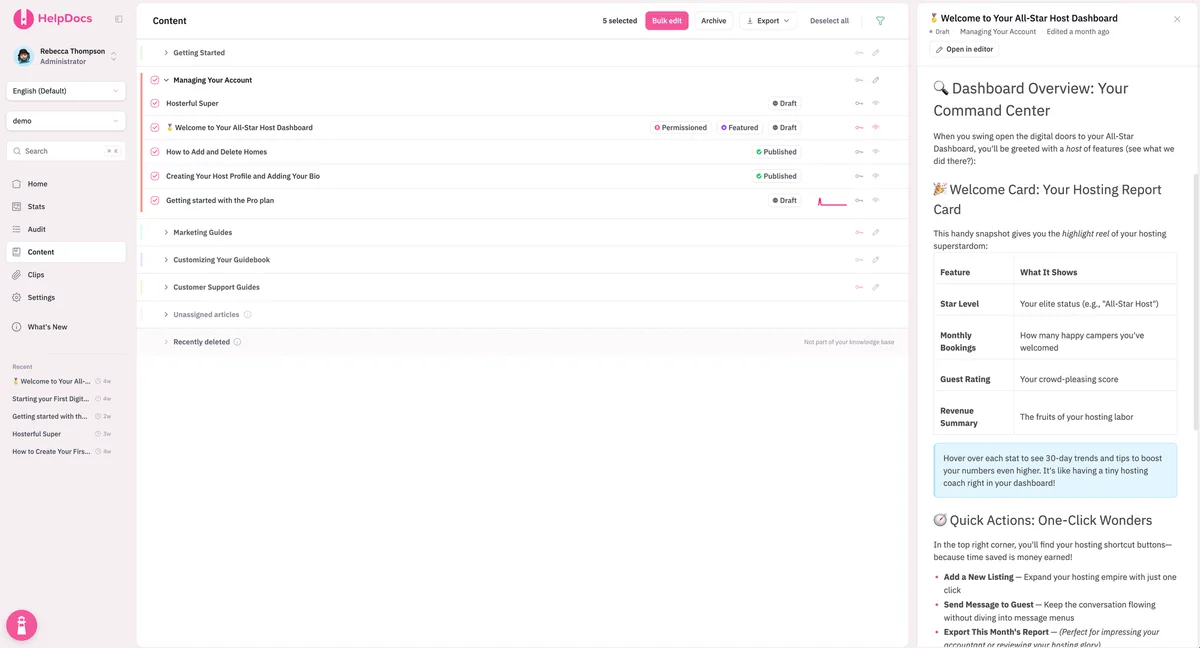
Notion is a flexible all-purpose workspace and wiki where teams write docs, run projects, and collaborate in real time, and it can publish public pages with Notion Sites. HelpDocs is a dedicated knowledge base for complex, authoritative documentation, internal or public, with the controls a growing docs team needs (permission groups, an audit trail, version history with side-by-side diffs, SSO) built in, rather than a blank canvas you assemble yourself.
HelpDocs is best for
Teams who want a fast, branded knowledge base, for customers or staff, with real help center search and analytics, enterprise controls like permission groups and SSO, and flat pricing you can buy without talking to sales, unlimited free public readers included.
Notion is best for
Teams who want one flexible workspace for real-time collaborative editing, notes, wikis, and projects, and are fine building and maintaining any published help center themselves inside Notion Sites.
Feature by feature
How they stack up, feature by feature
A side-by-side look at what HelpDocs and Notion each include, grouped by the job you're trying to do.
Setup & onboarding
How quickly you can go from signup to a live, branded knowledge base.
| Feature | HelpDocs | Notion |
|---|---|---|
| Free trial without talking to sales | Yes | Notion has a free plan and paid tiers you can start without sales.Checked against public sources. Worth verifying yourself. |
| Published, self-serve pricing | Yes | Notion publishes per-seat prices for Free, Plus, and Business. Enterprise is custom.Checked against public sources. Worth verifying yourself. |
| Standalone knowledge base (no support suite required) | Yes | Notion is a general workspace, so a customer help center is something you build yourself rather than a purpose-built product.Checked against public sources. Worth verifying yourself. |
| Live help center the same day | Yes | You can publish a Notion Site quickly, but shaping it into a real branded help center with navigation and search takes setup.Checked against public sources. Worth verifying yourself. |
| Starter templates and sample content | Yes | Notion has an enormous template gallery, though few are dedicated customer help centers.Checked against public sources. Worth verifying yourself. |
| Guided migration from other tools | Built-in importers for Zendesk Guide, Intercom Articles, Help Scout Docs, Document360, GitBook, ReadMe, Notion, Google Drive and more, plus GitHub: point it at a repo and its Markdown and MDX files become articles. | Notion imports from Word, HTML, CSV, PDF, Markdown, Confluence, and Evernote, but there is no guided migration for a customer-facing help center.Checked against public sources. Worth verifying yourself. |
Authoring & editing
The day-to-day writing experience for the people who maintain your docs.
| Feature | HelpDocs | Notion |
|---|---|---|
| WYSIWYG editor | Yes | Notion's block editor is one of its biggest strengths.Checked against public sources. Worth verifying yourself. |
| Custom HTML blocks in articles | HTML blocks are on every plan. Full HTML templates are on Bloom and up. | Notion supports embeds but not raw custom HTML blocks.Checked against public sources. Worth verifying yourself. |
| Reusable snippets and content variables | Clips are reusable blocks of content, static or dynamic, and Variables hold a single piece of text like a product name or support email. Both are on every plan, and a Variable dropped into a Clip can be overridden per article. | Synced blocks let you reuse content across pages, but there are no true content variables.Checked against public sources. Worth verifying yourself. |
| Category and nested navigation management | Yes | |
| Version history with side-by-side diff | Version history with side-by-side diffs, plus a full audit trail on Bloom and up. | Notion keeps page history (7 days on Free, 30 on Plus, 90 on Business, unlimited on Enterprise) but has no side-by-side diff.Checked against public sources. Worth verifying yourself. |
| Review and approval workflow builder | Limited | No built-in editorial review or approval workflow, though you can improvise with database status fields.Checked against public sources. Worth verifying yourself. |
AI & search
How well the knowledge base answers questions and deflects tickets on its own.
| Feature | HelpDocs | Notion |
|---|---|---|
| AI answers from your articles | Ask AI answers customers from your published articles. | Notion Agent and Enterprise Search answer from your workspace for internal users on Business and up, not for public help center visitors.Checked against public sources. Worth verifying yourself. |
| AI included in the base subscription | AI credits come with every plan. | Full Notion AI is bundled only on Business and Enterprise; Free and Plus get a limited trial, and Custom Agents are metered.Checked against public sources. Worth verifying yourself. |
| AI drafting and rewriting in the editor | Yes | Notion AI drafts and rewrites in the editor, but full access requires the Business plan.Checked against public sources. Worth verifying yourself. |
| AI style and tone enforcement | AI style enforcement is on Bloom and up. | Notion AI can change tone on request but cannot enforce a consistent style guide.Checked against public sources. Worth verifying yourself. |
| AI meta descriptions and SEO helpers | Yes | Notion Sites exposes basic SEO settings but no AI meta description or SEO helpers.Checked against public sources. Worth verifying yourself. |
| Full-text search with failed-search reporting | Yes | Notion has workspace search, but public Notion Sites search is basic and there is no failed-search reporting.Checked against public sources. Worth verifying yourself. |
| AI-powered semantic search | Ask AI draws on your monthly AI credits each time a reader uses it, so semantic search consumes the same pool as AI authoring. | Enterprise Search and Notion Agent are semantic but internal and gated to Business and up.Checked against public sources. Worth verifying yourself. |
| AI agent that resolves live conversations | HelpDocs is a knowledge base, not a chat agent. | Notion has no live chat or conversation-resolving agent.Checked against public sources. Worth verifying yourself. |
Branding & customization
Making the help center look and feel like your own product, not a vendor template.
| Feature | HelpDocs | Notion |
|---|---|---|
| Custom domain | A custom domain is included. | Publishing a Notion Site on a custom domain is a paid add-on on top of a paid plan, at $8/mo per domain billed annually or $10/mo month-to-month.Checked against public sources. Worth verifying yourself. |
| No-code color, font, and layout styling | Yes | Notion Sites offers basic fonts, colors, and layout options, well short of a full help center theme.Checked against public sources. Worth verifying yourself. |
| Custom CSS | Custom CSS is available from Sprout. | Notion Sites has no native custom CSS; teams reach for third-party tools like Super.Checked against public sources. Worth verifying yourself. |
| Custom JavaScript | Custom JavaScript is on every plan. | Not supported on Notion Sites.Checked against public sources. Worth verifying yourself. |
| Full HTML template control | Yes | You cannot control the underlying HTML template of a Notion Site.Checked against public sources. Worth verifying yourself. |
| Remove vendor branding (white-label) | No | Removing Notion branding comes bundled with the same paid custom-domain add-on ($8/mo per domain billed annually), and the site is still Notion under the hood.Checked against public sources. Worth verifying yourself. |
| Multi-brand help centers | Additional custom domains give each brand its own logo, colors, navigation and SEO over the same articles (2 included on Harvest, an extra fee otherwise). Brands that need different content run as separate accounts on one bill. | You get one notion.site domain on Free and five on paid plans, but there is no multi-brand help center management.Checked against public sources. Worth verifying yourself. |
Access & permissions
Who can read and edit what, and whether the platform meets security reviews.
| Feature | HelpDocs | Notion |
|---|---|---|
| Private or internal knowledge base | Yes | Private and internal wikis are exactly what Notion is best at.Checked against public sources. Worth verifying yourself. |
| Unlimited free reader accounts | Anonymous readers of a public help center are unlimited and free. Gated or authenticated readers can cost extra. | Anyone can view a public Notion Site for free, but internal collaborators need paid member seats. Guests are capped at 10 on Free, and unlimited on paid plans.Checked against public sources. Worth verifying yourself. |
| Content-level permission groups | Yes | Page-level permissions and teamspaces exist, with granular permissions on Business.Checked against public sources. Worth verifying yourself. |
| SSO and SAML | JWT SSO from Bloom, and SAML and OIDC SSO on Harvest. | SAML SSO is available on Business; enforced SSO and directory features come on Enterprise.Checked against public sources. Worth verifying yourself. |
| SCIM user provisioning | HelpDocs has limited SCIM provisioning, alongside SAML, OIDC, and JWT SSO. | SCIM provisioning is Enterprise-only on Notion.Checked against public sources. Worth verifying yourself. |
| Audit trail | Yes | Audit logging is limited to the Enterprise plan.Checked against public sources. Worth verifying yourself. |
Analytics
Understanding what readers search for, what works, and where content is failing.
| Feature | HelpDocs | Notion |
|---|---|---|
| Article views and engagement | Yes | Basic page analytics (a viewer list and views over time) on Free and Plus, advanced page analytics on Business, and workspace analytics on Enterprise. None of it is knowledge base article engagement.Checked against public sources. Worth verifying yourself. |
| Search and failed-search reporting | Yes | Notion does not report on searches or failed searches for a published site.Checked against public sources. Worth verifying yourself. |
| AI answer and deflection analytics | Yes | Notion is not a support tool and has no ticket deflection or AI answer analytics.Checked against public sources. Worth verifying yourself. |
| Reader feedback and ratings | Yes | No built-in article rating or reader feedback widget.Checked against public sources. Worth verifying yourself. |
| Contributor and team performance reports | Yes | No contributor leaderboard or knowledge base performance reporting.Checked against public sources. Worth verifying yourself. |
| Reporting data export | Yes | You can export your content, but there is little analytics data to export.Checked against public sources. Worth verifying yourself. |
Integrations & API
How the knowledge base plugs into the rest of your stack, and whether it doubles as a support suite or developer docs.
| Feature | HelpDocs | Notion |
|---|---|---|
| Public REST API and webhooks | HelpDocs has a read/write REST API, plus Slack webhooks for publish, feedback, and team events. It does not have general-purpose outbound webhooks. | Notion has a public API and webhooks for building on top of your workspace.Checked against public sources. Worth verifying yourself. |
| Integrations | Yes | Notion connects to Slack, Zapier, and many other apps.Checked against public sources. Worth verifying yourself. |
| Help desk integrations (Intercom, Zendesk) | Ships apps for Intercom, Zendesk, and more. | Notion has no native help desk integrations for ticket deflection.Checked against public sources. Worth verifying yourself. |
| Embeddable in-app help widget | The Lighthouse widget surfaces answers inside your product. | Notion has no embeddable help widget to surface answers inside your product.Checked against public sources. Worth verifying yourself. |
| Built-in live chat and messenger | Integrates with chat tools rather than replacing them. | No live chat.Checked against public sources. Worth verifying yourself. |
| Built-in ticketing and shared inbox | No | |
| OpenAPI and Swagger reference rendering | No | Notion cannot render OpenAPI or Swagger reference docs.Checked against public sources. Worth verifying yourself. |
Pricing
Pricing, side by side
Pricing below is accurate as of October 2026. HelpDocs is a flat monthly subscription for a set number of editors, with unlimited free public viewers. Notion charges per member seat, bundles full Notion AI only on Business and Enterprise, and treats public publishing on a custom domain as a paid Notion Sites add-on, so the real cost depends on team size, AI usage, and how public your help center needs to be.
Sprout
$99/mo billed annually (23% off). 5 editors, 1,000 AI credits/mo, AI meta features, AI drafts and rewrites, Ask AI, 3 languages, the Lighthouse widget, custom CSS and JavaScript, unlimited free public viewers.
Bloom
$239/mo billed annually (20% off). 15 editors, 5,000 AI credits/mo, AI meta features, AI drafts and rewrites, Ask AI, AI improve, AI style enforcement, 20 languages, audit trail, advanced permissioning, embedded SSO (JWT), the Lighthouse widget, custom CSS and JavaScript, custom HTML templating, unlimited free public viewers.
Harvest
$399/mo billed annually (20% off). 25 editors, 10,000 AI credits/mo, AI meta features, AI drafts and rewrites, Ask AI, AI improve, AI style enforcement, unlimited languages, audit trail, advanced permissioning, SSO with anonymous mode, IP restriction, the Lighthouse widget, custom CSS and JavaScript, custom HTML templating, unlimited free public viewers.
Free
For individuals and small teams. Up to 10 guests, one notion.site domain, 7-day page history, a limited Notion AI trial, and basic Notion Sites publishing.
Plus
Billed annually ($12 month-to-month). Unlimited members and guests, custom Sites and forms, 30-day page history.
Business
Billed annually ($24 month-to-month). Adds full Notion AI (Notion Agent, AI Meeting Notes, and Enterprise Search in beta), SAML SSO, granular database permissions, and 90-day page history.
Enterprise
Contact sales. Adds SCIM provisioning, audit log, advanced security, and zero data retention for AI.
Notion AI Custom Agents
Metered, on top of Business or Enterprise seats. Standard Notion AI is bundled into Business; Custom Agents bill by credit.
The bottom line: As of October 2026, Notion's per-seat price is low: a five-person team on Business runs about $100/mo ($20 x 5, annual), plus $8/mo per custom domain billed annually and any Custom Agent credits. HelpDocs Sprout is $129/mo ($99 annually) for 5 editors and Bloom is $299/mo ($239 annually) for 15, with unlimited free public readers and AI credits included. Notion is often cheaper to start, but you are buying a general workspace and building the help center yourself. HelpDocs costs more upfront and gives you a purpose-built, branded customer help center with search, analytics, and deflection out of the box.
Switching
Switching from Notion
Moving from Notion to HelpDocs is mostly a content export and cleanup exercise, since Notion is a workspace rather than a dedicated help center. Notion is a built-in migration source, so an integration token is enough for HelpDocs to lift the pages over without an export, and you then organize them into categories and navigation built for self-serve support. The upside is that you end with a branded public help center with real search and analytics, instead of a Notion Site you keep styling by hand. You can draft and structure your articles in HelpDocs while your Notion workspace stays exactly as it is.
- 1In Notion, export the pages or teamspace you use as your help content (Markdown and HTML export works well).
- 2Create your categories and navigation in HelpDocs to match how customers actually search.
- 3Import or paste your content into HelpDocs, then clean up formatting and fix any Notion-specific embeds.
- 4Style your help center, add your logo and colors, and point your custom domain at HelpDocs.
- 5Turn on search, analytics, and the Lighthouse widget so you can start measuring deflection.
Honest trade-offs
Why teams pick one over the other
Why teams choose HelpDocs
- Purpose-built knowledge base for authoritative docs (internal or public), not a general workspace you have to shape into one yourself.
- A custom domain is included on every plan, where publishing a Notion Site on your own domain is an $8/mo per domain add-on billed annually.
- Fast full-text search with failed-search reporting built for self-serve support, which a published Notion Site does not report on at all.
- Real knowledge base analytics: article views, reader feedback, and ticket deflection insights.
- Deep customization with custom CSS and JavaScript from Sprout and custom HTML templating on Bloom and up.
- AI credits bundled into every plan, 1,000/mo on Sprout up to 10,000 on Harvest, with drafts, rewrites, and Ask AI answering customers on every plan, where full Notion AI needs the Business plan and Custom Agents are metered at $10 per 1,000 credits.
- Help desk integrations for Intercom and Zendesk, plus the Lighthouse widget on every plan, to surface answers inside your product. Notion has neither.
- Governance on published plans: permission groups, an audit trail and JWT SSO from Bloom, then SAML and OIDC SSO with IP restriction on Harvest. Notion keeps its audit log and SCIM on the contact-sales Enterprise plan.
- Built for a docs set that has outgrown a wiki: version history with side-by-side diffs, reusable Clips and Variables, and room to grow, with 25 editors on Harvest, volume discounts on extra editors past 100, and SOC 2 and ISO 27001 certification in progress.
Why teams choose Notion
- Extremely flexible block editor that doubles as docs, notes, wikis, and databases.
- One all-in-one workspace for internal knowledge, projects, and collaboration.
- Low per-seat starting cost, with a genuinely useful free plan.
- Familiar tool many teams already use every day, so there is little to learn.
- Huge template gallery and a large ecosystem of integrations and add-ons.
- Excellent for collaborative, free-form docs, notes, and cross-functional wikis.
- Public API and webhooks for building custom workflows on top of your content.
FAQ
Questions about HelpDocs vs Notion
Can I use Notion as a knowledge base?
Is HelpDocs cheaper than Notion?
How do I move my content from Notion to HelpDocs?
Does Notion have AI for a knowledge base?
Can I publish a public help center with Notion?
Should I keep Notion and add HelpDocs?
Is HelpDocs a good Notion alternative?
Not decided yet
Still building a shortlist?
A head-to-head is the wrong shape when you have not narrowed the field yet. Notion is one of twelve tools in our wider roundup, scored on the same criteria.
Ready to switch to HelpDocs?
Create, organize, translate, and connect your docs without the admin sprawl of a support suite.
No credit card required.