Knowledge base vs help desk
Where a knowledge base ends and a help desk begins, and why you often want both.
Picture your first week of running customer support. Tickets are trickling in, someone hands you a budget, and two terms keep showing up that sound almost identical: knowledge base and help desk. If you’ve quietly nodded along in a meeting while wondering which is which, you’re in good company.
They’re related, they usually sit right next to each other, and plenty of vendors bundle them together, so the mix-up is easy to make. They do genuinely different jobs, though, and getting the knowledge base vs help desk distinction straight helps you pick the right tool for the right moment. For most teams, that moment turns out to be “both.”
The quick version: a knowledge base is your published, self-serve library of answers that customers read on their own, and a help desk is the system your team uses to receive, track, and reply to individual support requests. One scales your best answers to everyone. The other handles the questions that really need a human. Both are worth understanding properly, so let’s take them one at a time.
What is a knowledge base?
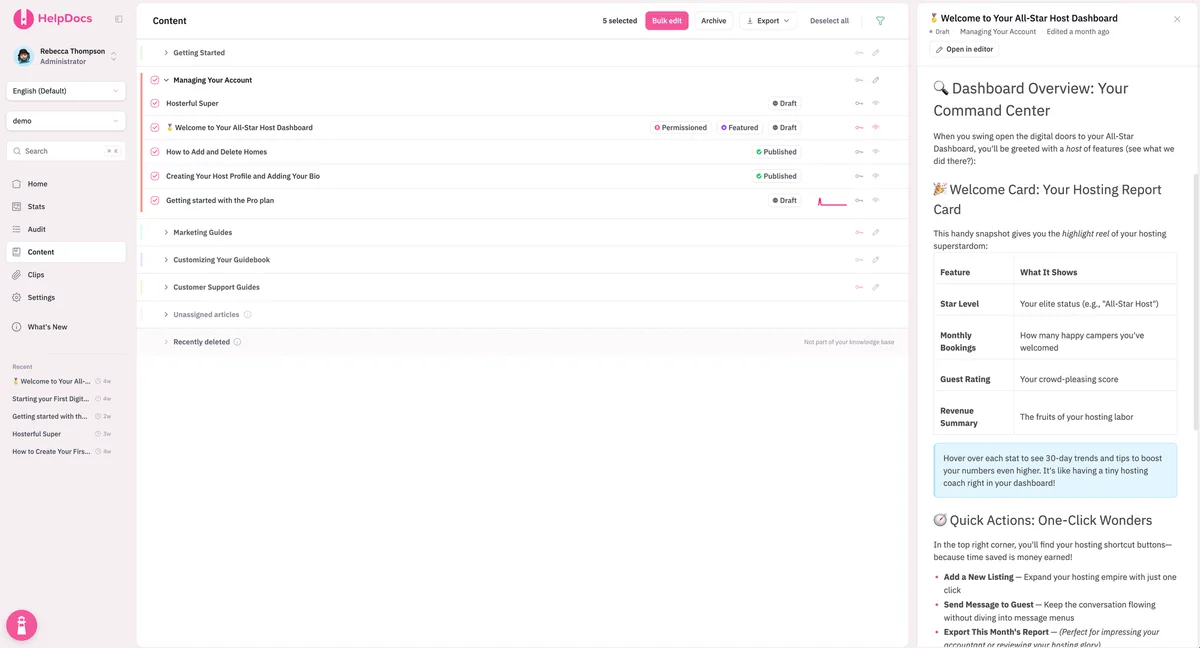
A knowledge base (you’ll also see it called a help center) is a searchable collection of articles, guides, FAQs, and how-tos that answers common questions about your product or service. Customers land on it (usually through search or a help link), find what they need, and get on with their day without ever opening a ticket. It’s easy to confuse “help center” with “help desk,” but they’re different things: a help center is the knowledge base itself, while a help desk is the ticketing tool we’ll get to next. It’s the public face of your support documentation, and if you want the deeper definition, we cover it in what is documentation.
A good knowledge base is:
- Self-serve. Customers help themselves, on their own schedule, at 2am if they want.
- One-to-many. You write an article once and it answers the same question for thousands of people.
- Proactive. It sits there quietly, heading off questions before they ever reach your team.
- Always on. No queue, no wait time, no “our office hours are.”
Knowledge bases come in all sizes, from a handful of FAQs to full-blown product documentation with categories, search, and version control. The benefits of a knowledge base go well beyond deflecting tickets, but ticket deflection is the headline you’ll notice first: fewer repetitive questions landing in your team’s lap. For a broader take, HelpDocs has a friendly primer on what a knowledge base actually is.
What is a help desk?
A help desk is the software your support team uses to manage incoming customer conversations. When someone emails, chats, or fills out a contact form, that request becomes a ticket. The help desk routes it, assigns it, tracks its status, and keeps the whole back-and-forth in one place until it’s resolved. Think of it as mission control for every conversation in flight.
A help desk is:
- Assisted. A human (or increasingly an AI agent) works the request directly.
- One-to-one. Each conversation is tailored to one customer and their specific situation.
- Reactive. It responds to requests as they come in.
- Accountable. Tickets have owners, statuses, and history, so nothing slips through the cracks.
Think refunds, account-specific bugs, billing disputes, the occasional venting email, anything that needs judgment or access to a particular customer’s data. That’s help desk territory. You’ve probably met a few of the popular ones already: Zendesk, Intercom, Freshdesk, and Help Scout.
Knowledge base vs help desk: the key differences
Here they are side by side, which is probably why you’re here.
| Knowledge base | Help desk | |
|---|---|---|
| Who does the work | The customer (self-serve) | Your team or an AI agent (assisted) |
| Reach | One-to-many | One-to-one |
| Timing | Proactive, always available | Reactive, responds to requests |
| Content | Published articles and guides | Private tickets and conversations |
| Best for | Common, repeatable questions | Unique, account-specific issues |
| Availability | 24/7, no queue | Limited by team capacity and hours |
| Scales by | Writing better content | Adding people or automation |
The cleanest way to keep the difference in your head: a knowledge base is content, and a help desk is a workflow. The knowledge base publishes answers to the world, while the help desk manages the questions the content couldn’t answer on its own.
When to use which
Reach for a knowledge base when the question is common, the answer is stable, and there’s no account-specific detail involved. “How do I reset my password?” “What are your shipping times?” “How do I export my data?”
These get asked hundreds of times, and the answer is the same every time. Writing it down once beats typing it out again and again, and it saves your future self a lot of repetition.
A help desk is the better fit when the request is specific to one customer, needs access to their data, requires a decision, or is emotionally charged.
“Why was I charged twice?” “My account is locked and I can’t get in.” “This feature isn’t working for my setup.” These are the moments a human needs to look at the details.
The catch is that customers don’t sort themselves neatly into these buckets. Plenty will open a ticket for something your knowledge base already answers, simply because they didn’t look, or couldn’t find it. And plenty of self-service attempts stall halfway and need to escalate to a person. Which brings us to the real answer.
Why most teams run both
For all the “vs” in the framing, this isn’t really a competition. The two tools do their best work as a pair.
The research backs it up. Harvard Business Review found that 81% of customers try to resolve an issue on their own before reaching out to a live agent (Harvard Business Review). People genuinely want to self-serve. The follow-through is more sobering, though: a large share of those self-service attempts still stall before they fully resolve.
Put those two truths together and the strategy writes itself. Most customers start by trying to help themselves, so you need a knowledge base that’s genuinely good enough to catch that traffic. But a big chunk of those attempts won’t fully resolve, so you need a help desk ready to catch whatever falls through.
Skip the knowledge base and your team drowns in repetitive tickets. Skip the help desk and every unresolved self-service attempt turns into a frustrated dead end.
Run them together and they make each other better. Your knowledge base deflects the easy, repeatable questions so your team can spend real time on the hard ones.
And your help desk quietly doubles as a content factory: every question that gets asked twice is a signal that you’re missing an article. Feed those recurring questions back into your knowledge base and you’ll watch the ticket queue shrink over time. We dig into this loop more in our guide to self-service support.
The bottom line
A knowledge base answers questions before they become tickets. A help desk handles the tickets that show up anyway. They aren’t competitors so much as two halves of one support system: one proactive and one-to-many, the other reactive and one-to-one.
Start with whichever pain is loudest (repetitive questions point to a knowledge base gap, unmanaged chaos points to a help desk gap), then add the other when you’re ready. Your customers get faster answers, and your team gets to focus on the problems that actually need a person.