 vs
vs
HelpDocs vs MadCap Flare
One is a hosted knowledge base you launch in an afternoon. The other is a Windows technical authoring suite. Here is where each one wins.
The verdict
These two tools solve genuinely different problems.
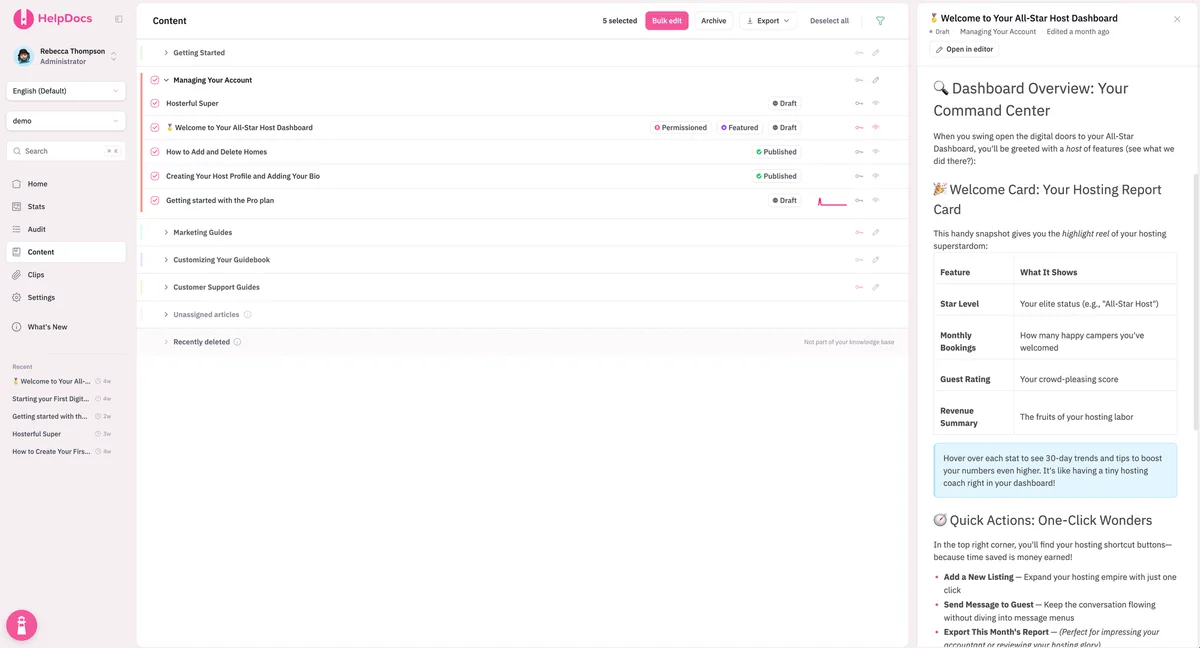
MadCap Flare is a professional technical authoring suite: topic-based writing, condition tags, and single-sourcing to HTML5, PDF, print, and Word from one project, and it is very good at that. HelpDocs is a hosted knowledge base that handles complex documentation without the enterprise overhead: permission groups, an audit trail, version history with side-by-side diffs, and SSO, with flat published pricing, AI credits on every plan, unlimited free public readers, and no desktop app to install.
HelpDocs is best for
Documentation, support, and product teams who want enterprise controls in a customer-facing help center they can run from a browser on any OS, with transparent pricing and AI included rather than a quote and a per-author license.
MadCap Flare is best for
Technical writing teams producing large, structured documentation sets that must ship as PDF and print as well as web, need condition tags and variables to single-source many product variants, and work in regulated industries like aerospace, medical devices, or manufacturing. If print output and conditional single-sourcing are hard requirements, Flare is the better tool and HelpDocs is not a substitute.
Feature by feature
How they stack up, feature by feature
A side-by-side look at what HelpDocs and MadCap Flare each include, grouped by the job you're trying to do.
Setup & onboarding
How quickly you can go from signup to a live, branded knowledge base.
| Feature | HelpDocs | MadCap Flare |
|---|---|---|
| Free trial without talking to sales | Yes | MadCap's free-trials page offers Flare free for 30 days with no credit card required, and Flare Online has its own free 30-day trial.Checked against public sources. Worth verifying yourself. |
| Published, self-serve pricing | Yes | Flare Desktop is published at $3,150 per author per year and buyable online. All three Flare Online tiers say Contact Sales on the pricing page, though MadCap's Flare Online trial page does publish a $537 per user per month starting price for Individual.Checked against public sources. Worth verifying yourself. |
| Standalone knowledge base (no support suite required) | Yes | Yes |
| Live help center the same day | Yes | Flare is a professional authoring tool with a real learning curve. Expect project, target, and skin setup before your first publish, and a Windows install for the desktop app.Checked against public sources. Worth verifying yourself. |
| Starter templates and sample content | Yes | Flare ships project templates, and MadCap publishes a separate Flare Templates library.Checked against public sources. Worth verifying yourself. |
| Guided migration from other tools | Built-in importers for Zendesk Guide, Intercom Articles, Help Scout Docs, Document360, GitBook, ReadMe, Notion, Google Drive and more, plus GitHub: point it at a repo and its Markdown and MDX files become articles. | MadCap's Flare page lists import support for Word, Excel, Confluence, FrameMaker, RoboHelp, DITA and more, but there is no one-click import from a hosted help center.Checked against public sources. Worth verifying yourself. |
Authoring & editing
The day-to-day writing experience for the people who maintain your docs.
| Feature | HelpDocs | MadCap Flare |
|---|---|---|
| WYSIWYG editor | Yes | Flare Desktop uses an XML editor with a WYSIWYG view. Flare Online adds a lighter browser editor aimed at SMEs and quick edits.Checked against public sources. Worth verifying yourself. |
| Custom HTML blocks in articles | HTML blocks are on every plan. Full HTML templates are on Bloom and up. | Topics are XHTML files on disk, so you have complete markup control.Checked against public sources. Worth verifying yourself. |
| Reusable snippets and content variables | Clips are reusable blocks of content, static or dynamic, and Variables hold a single piece of text like a product name or support email. Both are on every plan, and a Variable dropped into a Clip can be overridden per article. | Snippets, variables, and condition tags are Flare's core strength.Checked against public sources. Worth verifying yourself. |
| Category and nested navigation management | Yes | |
| Version history with side-by-side diff | Version history with side-by-side diffs sits in the editor. | Uploading a project to Flare Online connects it to an integrated Git source control system with file history and diffs.Checked against public sources. Worth verifying yourself. |
| Review and approval workflow builder | Limited | Flare Online adds SME review seats, tasks, checklists, and review workflows.Checked against public sources. Worth verifying yourself. |
AI & search
How well the knowledge base answers questions and deflects tickets on its own.
| Feature | HelpDocs | MadCap Flare |
|---|---|---|
| AI answers from your articles | Yes | AI Assist is an authoring assistant, not a reader-facing answer engine. Semantic answers over published content mean buying MadCap Syndicate, which is quote-only.Checked against public sources. Worth verifying yourself. |
| AI included in the base subscription | Every plan includes monthly AI credits with no second vendor. | Flare Online lists AI Assist as included, but MadCap's own AI Assist guide says you must connect your own OpenAI API key, which requires payment to OpenAI.Checked against public sources. Worth verifying yourself. |
| AI drafting and rewriting in the editor | Yes | AI Assist drafts, rewrites, summarizes, and translates once your own ChatGPT key is connected, with GPT-3.5 through GPT-5 and GPT-5 Mini selectable as the model.Checked against public sources. Worth verifying yourself. |
| AI style and tone enforcement | House style enforcement with AI is on Bloom and up. | Style and terminology enforcement comes from third-party plugins such as Acrolinx or HyperSTE.Checked against public sources. Worth verifying yourself. |
| AI meta descriptions and SEO helpers | Yes | AI Assist can be prompted to optimize text for search, but there is no dedicated metadata generator.Checked against public sources. Worth verifying yourself. |
| Full-text search with failed-search reporting | Yes | Flare Online analytics reports search phrases used and search phrases that returned no results.Checked against public sources. Worth verifying yourself. |
| AI-powered semantic search | Ask AI draws on your monthly AI credits each time a reader uses it, so semantic search consumes the same pool as AI authoring. | HTML5 output search is keyword-based. Semantic search means adding MadCap Syndicate or a plugin such as SearchUnify.Checked against public sources. Worth verifying yourself. |
| AI agent that resolves live conversations | No | Flare is an authoring and publishing platform, not a live-chat agent.Checked against public sources. Worth verifying yourself. |
Branding & customization
Making the help center look and feel like your own product, not a vendor template.
| Feature | HelpDocs | MadCap Flare |
|---|---|---|
| Custom domain | Yes | Flare Online site management covers domains and vanity URLs.Checked against public sources. Worth verifying yourself. |
| No-code color, font, and layout styling | Yes | The Skin Editor and stylesheet editor are visual, though they assume you know Flare's skin and target concepts.Checked against public sources. Worth verifying yourself. |
| Custom CSS | Yes | Full stylesheet control, and a real strength of Flare.Checked against public sources. Worth verifying yourself. |
| Custom JavaScript | Custom JavaScript is on every plan. | You own the output files, so any script can go in.Checked against public sources. Worth verifying yourself. |
| Full HTML template control | Yes | Master pages, page layouts, and HTML5 skins give near-total control of the published output, deeper than most hosted platforms.Checked against public sources. Worth verifying yourself. |
| Remove vendor branding (white-label) | Keeps a small HelpDocs mark. | Published output carries no MadCap branding.Checked against public sources. Worth verifying yourself. |
| Multi-brand help centers | Additional custom domains give each brand its own logo, colors, navigation and SEO over the same articles (2 included on Harvest, an extra fee otherwise). Brands that need different content run as separate accounts on one bill. | One project can publish many targets, and Flare Online can host multiple sites under different domains.Checked against public sources. Worth verifying yourself. |
Access & permissions
Who can read and edit what, and whether the platform meets security reviews.
| Feature | HelpDocs | MadCap Flare |
|---|---|---|
| Private or internal knowledge base | Yes | Flare Online can publish private output behind password-protected user access.Checked against public sources. Worth verifying yourself. |
| Unlimited free reader accounts | Anonymous readers of a public help center are unlimited and free. Gated or authenticated readers can cost extra. | Published HTML5 output is a static site, so public readers cost nothing on either platform. The difference is the author side, where Flare bills per author per year.Checked against public sources. Worth verifying yourself. |
| Content-level permission groups | Permission groups are on Bloom and up. | Flare's model is condition tags and separate targets per audience rather than per-article permission groups on one live site.Checked against public sources. Worth verifying yourself. |
| SSO and SAML | JWT SSO from Bloom, and SAML and OIDC SSO on Harvest. | Flare Online supports SAML 2.0 single sign-on for licensed users.Checked against public sources. Worth verifying yourself. |
| SCIM user provisioning | HelpDocs has limited SCIM provisioning, alongside SAML, OIDC, and JWT SSO. | Nothing MadCap publishes covers automated SCIM provisioning.Checked against public sources. Worth verifying yourself. |
| Audit trail | The audit trail is on Bloom and up. | Flare Online keeps activity history and audit logging alongside Git commit history.Checked against public sources. Worth verifying yourself. |
Analytics
Understanding what readers search for, what works, and where content is failing.
| Feature | HelpDocs | MadCap Flare |
|---|---|---|
| Article views and engagement | Yes | Flare Online reports topics viewed, context-sensitive Help calls, browsers, and operating systems, with a 30-day default window.Checked against public sources. Worth verifying yourself. |
| Search and failed-search reporting | Yes | The no-results report is one of the better parts of Flare Online analytics.Checked against public sources. Worth verifying yourself. |
| AI answer and deflection analytics | Yes | There is nothing to report on, because reader-facing AI answers are not part of Flare itself.Checked against public sources. Worth verifying yourself. |
| Reader feedback and ratings | Yes | MadCap Feedback, which added topic ratings and comments to output, no longer appears in MadCap's store or product line. You bolt on your own feedback mechanism.Checked against public sources. Worth verifying yourself. |
| Contributor and team performance reports | Yes | Flare Online has tasks, activity feeds, and project reporting, but no contributor leaderboard.Checked against public sources. Worth verifying yourself. |
| Reporting data export | Yes | Flare Desktop's analysis reports export cleanly, but Flare Online analytics is dashboard-first.Checked against public sources. Worth verifying yourself. |
Integrations & API
How the knowledge base plugs into the rest of your stack, and whether it doubles as a support suite or developer docs.
| Feature | HelpDocs | MadCap Flare |
|---|---|---|
| Public REST API and webhooks | HelpDocs has a read/write REST API, plus Slack webhooks for publish, feedback, and team events. It does not have general-purpose outbound webhooks. | MadCap publishes a Flare Plugin API and a Help Viewer SDK, plus Git and CI/CD hooks, but not a public REST API for creating and updating content.Checked against public sources. Worth verifying yourself. |
| Integrations | Yes | MadCap Connect plugins plus a broad third-party plugin ecosystem (SearchUnify, Acrolinx, FlareLint, Markdown Plugin II and more).Checked against public sources. Worth verifying yourself. |
| Help desk integrations (Intercom, Zendesk) | Yes | MadCap Publishing Connectors push Flare content into Salesforce, Zendesk, and ServiceNow, and MadCap now lists them inside the Flare Online Individual subscription. It is one-way publishing, and there is no Intercom connector.Checked against public sources. Worth verifying yourself. |
| Embeddable in-app help widget | The Lighthouse widget drops into your product. | Flare does context-sensitive Help calls and micro content, but there is no drop-in in-app widget.Checked against public sources. Worth verifying yourself. |
| Built-in live chat and messenger | No | No |
| Built-in ticketing and shared inbox | No | No |
| OpenAPI and Swagger reference rendering | No | You embed Swagger UI in the output or import a converted OpenAPI spec rather than pointing Flare at a spec file. Even so, Flare suits developer documentation well.Checked against public sources. Worth verifying yourself. |
Pricing
Pricing, side by side
As of October 2026, MadCap publishes some prices and quotes the rest. Flare Desktop is a subscription, listed at $3,150 per author per year on MadCap's pricing page and store and as $263 per user per month billed annually on the free-trials page, and you can buy it online today. All three Flare Online tiers say Contact Sales on the pricing page, but MadCap's own Flare Online trial page publishes a starting price of $537 per user per month billed annually for Individual, licensed per user on a 12-month commitment. Every product in MadCap's store is now a subscription with no perpetual license on sale, and reader-facing AI and semantic search sit in MadCap Syndicate, a separate quote-only product.
Sprout
$99/mo billed annually (23% off). 5 editors, 1,000 AI credits/mo, AI meta features, AI drafts and rewrites, Ask AI, 3 languages, the Lighthouse widget, custom CSS and JavaScript, unlimited free public viewers.
Bloom
$239/mo billed annually (20% off). 15 editors, 5,000 AI credits/mo, AI meta features, AI drafts and rewrites, Ask AI, AI improve, AI style enforcement, 20 languages, audit trail, advanced permissioning, embedded SSO (JWT), the Lighthouse widget, custom CSS and JavaScript, custom HTML templating, unlimited free public viewers.
Harvest
$399/mo billed annually (20% off). 25 editors, 10,000 AI credits/mo, AI meta features, AI drafts and rewrites, Ask AI, AI improve, AI style enforcement, unlimited languages, audit trail, advanced permissioning, SSO with anonymous mode, IP restriction, the Lighthouse widget, custom CSS and JavaScript, custom HTML templating, unlimited free public viewers.
Flare Desktop (Starter)
A subscription, published and buyable online, and shown elsewhere on MadCap's site as $263/user/mo billed annually. On-prem Windows authoring and publishing only: no hosting, no cloud collaboration, no analytics.
Flare Online, Individual
MadCap's pricing page says Contact Sales; its Flare Online trial page publishes this as a starting price, billed annually on a 12-month commitment. 1 to 2 authors. Includes Flare Desktop per author, 1 SME review seat per author, 20 GB storage, hosting, analytics, AI Assist.
Flare Online, Team
3 to 5 authors. Adds 2 SME reviewer seats per author, 250 GB storage, and onboarding.
Flare Online, Business
6+ authors. Adds 5 SME reviewer seats per author and 500 GB storage. Onboarding is an additional fee.
MadCap Syndicate AI
Now branded MadCap Syndicate AI. Separate product for AI-ready delivery, semantic search, RAG, and MCP access across channels. MadCap publishes no figure for it at all.
The bottom line: As of October 2026 the models are not comparable line for line, but the arithmetic is stark. One Flare Desktop author is $3,150 a year and gets you no hosting, no analytics, and no cloud collaboration, while Flare Online Individual starts at $537 per user per month, which is $6,444 a year per author. HelpDocs Sprout is $99/mo billed annually, or $1,188 a year, and that covers five editors, unlimited free public readers, hosting, analytics, and AI credits, while extra storage, SME reviewer seats, and MadCap Syndicate are all separate purchases on the Flare side and AI Assist needs your own paid OpenAI key. Flare earns its price when you genuinely need print and PDF single-sourcing at scale; if you are building a web help center, you are paying for a lot of machinery you will not use.
Switching
Switching from MadCap Flare
Moving from MadCap Flare to HelpDocs is a real project rather than a click, because a Flare project is a folder of XHTML topics plus TOCs, targets, skins, snippets, variables, and condition tags. The content itself travels well: topics are HTML, so they map into HelpDocs articles cleanly, and you can bring them in via CSV import or the HelpDocs API. What does not travel is the single-sourcing machinery. Condition tags collapse into one published version, snippets and variables need flattening or rebuilding, and PDF or print targets do not have an equivalent in HelpDocs beyond per-article PDF and Word export. Be honest with yourself about that before you start: if your PDF deliverables are contractual or regulated, keep Flare for those and use HelpDocs for the customer-facing help center instead of trying to replace one with the other. Since there is no Flare importer, the topics arrive as files or a crawl of your published output, both of which are covered here.
- 1Build your HTML5 target in Flare one last time, or copy the topic files straight out of the project.
- 2Decide which condition tags and variables to resolve, then flatten the topics to a single published version.
- 3Map topics and TOC structure into a HelpDocs CSV, or push them through the HelpDocs API.
- 4Import into HelpDocs and check headings, images, tables, and internal links came across.
- 5Point your custom domain at HelpDocs and redirect the old Flare output URLs so search rankings follow.
- 6Turn on AI answers and the Lighthouse widget, then invite your team (public readers are always free).
Honest trade-offs
Why teams pick one over the other
Why teams choose HelpDocs
- Fully browser-based, so there is no Windows-only desktop app and no per-author install.
- Public, flat pricing you can buy without a sales call. MadCap's pricing page says Contact Sales for all three Flare Online tiers, and the one published figure, $537 per user per month for Individual, sits on its trial page.
- $99/mo billed annually covers five editors, versus $3,150 per author per year for Flare Desktop alone.
- AI included in the subscription with monthly credits, instead of an AI Assist integration that needs your own paid OpenAI key.
- Reader-facing AI answers and semantic search are included from Bloom, not a separate MadCap Syndicate purchase.
- Live help center in an afternoon, with hosting, search, and analytics on from day one.
- Enterprise controls without the enterprise install: permission groups, an audit trail and JWT SSO from Bloom, SAML and OIDC SSO on Harvest, and SOC 2 and ISO 27001 certification in progress.
- Room for a full documentation team: 25 editors on Harvest, with volume discounts on extra editors past 100, all at a published price.
- One-click migrations from Zendesk, Intercom, Help Scout, Readme, Helpjuice, and ProProfs.
- Built-in reader feedback and ratings on published articles. MadCap Feedback, which added topic ratings and comments to Flare output, no longer appears in MadCap's store or product line, so you bolt on your own.
- Lighthouse widget on every plan puts contextual answers directly inside your product, where Flare offers context-sensitive Help calls rather than a drop-in widget.
- Bulk editing, content health scoring, and a contributor leaderboard for keeping a growing library current.
Why teams choose MadCap Flare
- True single-sourcing: write once and publish HTML5, PDF, print, Word, PowerPoint, and SCORM from the same topics.
- Condition tags let one project produce many product, audience, and regional variants without duplicating content.
- Snippets, variables, and cross-references are deeper and more rigorous than anything in HelpDocs.
- Print and PDF output with page layouts, indexes, and generated front matter, which HelpDocs does not attempt.
- Master pages, page layouts, and HTML5 skins give more control over published markup than a hosted platform can.
- Integrated Git source control with branching, plus CI/CD publishing for docs-as-code teams.
- Formal SME review workflows with dedicated reviewer seats, tasks, and checklists.
- Mature translation and localization workflows, plus MadTranslations services and MadCap Lingo.
- Twenty years of track record in regulated technical documentation (aerospace, defense, medical, manufacturing), and a path up to IXIA CCMS for DITA.
- Works fully offline, and you own the output files outright with no vendor branding.
FAQ
Questions about HelpDocs vs MadCap Flare
Is HelpDocs cheaper than MadCap Flare?
How much does MadCap Flare cost in 2026?
Do I need Windows to use MadCap Flare?
Can I migrate from MadCap Flare to HelpDocs?
Is MadCap Flare or HelpDocs better for a customer-facing knowledge base?
Does MadCap Flare have AI?
Can HelpDocs produce PDFs and printed manuals like MadCap Flare?
Is HelpDocs a good MadCap Flare alternative?
Not decided yet
Still building a shortlist?
A head-to-head is the wrong shape when you have not narrowed the field yet. Our roundup compares twelve knowledge base tools on setup, search, branding and real pricing.
Ready to switch to HelpDocs?
Create, organize, translate, and connect your docs without the admin sprawl of a support suite.
No credit card required.