AI knowledge management
How AI helps teams capture, organize, and surface what they know.
Somewhere in your company, the answer to the question a customer just asked already exists. It’s buried in an old ticket, a Slack thread, a doc three people have quietly edited, or an article nobody remembers writing. The problem was never that your team didn’t know the answer. It’s that the knowledge was scattered too widely for anyone to find it in the moment they needed it. Closing that gap is exactly what AI knowledge management is built to do.
AI knowledge management is the practice of using artificial intelligence to help teams capture, organize, surface, and maintain what they collectively know. It builds on ordinary knowledge management, the discipline of turning scattered expertise into something findable, and adds a layer that can read, summarize, and answer far faster than any human team. This guide walks through what AI in knowledge management actually means, where it helps, where it can go wrong, and how it relates to the knowledge base you may already run. Think of this as the “start here” page for everything AI in your help center.
What is AI knowledge management?
AI knowledge management is what you get when you point machine learning and large language models at the everyday work of keeping knowledge useful. Instead of a person manually writing every article, tagging every doc, and answering every repeat question, AI takes on the heavy, repetitive parts. It reads your existing content, understands what a question means rather than just matching keywords, and returns an answer in plain language.
This matters now for two reasons. Gartner found that 91% of customer service leaders are under pressure to implement AI in 2026, so it’s no longer a fringe experiment. And the payoff is real: McKinsey estimates generative AI could automate activities that absorb 60 to 70% of the time employees spend today, much of it the searching and summarizing that knowledge work is made of.
How does AI change a classic knowledge base?
A traditional knowledge base is a library. You write articles, organize them into categories, and readers browse or search to find what they need. It works, but it puts the effort on the reader, who has to guess the right search terms and skim results until something fits.
An AI knowledge base flips that. Rather than handing back a list of ten articles, it reads across your whole library and gives one direct answer, grounded in your content, in the reader’s own words. The articles still matter enormously, because they’re the source the AI draws from. We unpack that shift in what an AI knowledge base is, and the mechanics of how the answers get generated in how AI uses your knowledge base.
What can AI actually do with your knowledge?
Most of the value clusters into four jobs: answering questions, authoring content, organizing what you have, and analyzing how it performs. Here’s how AI helps across that lifecycle.
| Use case | What AI does | What it looks like in practice |
|---|---|---|
| Answering | Understands a question and returns a grounded reply | A support bot or search box that gives a direct answer, not a link list |
| Authoring | Drafts, rewrites, and tightens articles | Turning a resolved ticket into a first-draft help article |
| Organizing | Suggests categories, tags, and related links | Auto-tagging new content and flagging duplicates |
| Analyzing | Spots gaps, stale content, and demand patterns | Surfacing the questions your knowledge base can’t yet answer |
Answering is the use case most people picture first. An AI agent sits on your help center or inside your product and resolves the routine, repeatable questions on its own, escalating the genuinely tricky ones to a person. Done well, it deflects the easy tickets so your team can focus on the hard ones, which is the whole point of AI for customer support.
Authoring is where AI quietly saves the most time. It can turn a messy support transcript into a clean draft, rewrite a wall of text into scannable steps, or catch the gaps and jargon a busy writer misses. Our guide to the AI content improver covers how to use it without letting quality slip.
Organizing and analyzing are the less glamorous jobs that keep a knowledge base healthy at scale. AI can suggest where a new article belongs, propose tags, flag two articles that contradict each other, and, crucially, tell you which questions people keep asking that you have no content for. Those blind spots used to take a human trawling through search logs. Now they surface on their own.
What are the risks of AI knowledge management?
The headline risk is accuracy. A language model is fluent by design, so a wrong answer can sound just as confident as a right one. If the AI invents a detail or stitches together two half-truths, it does so in polished prose, and readers may not think to double-check.
The main defense is grounding, which means restricting the AI to answer only from your approved content rather than from whatever it absorbed during training. A well-grounded system quotes your knowledge base and says “I don’t know” when the answer isn’t there, instead of guessing. That single design choice is the difference between a helpful assistant and a liability.
The other risks are quieter but just as real. AI trained on stale content will confidently repeat outdated answers, so maintenance matters more once AI is in the loop, not less. And the old self-service gap does not disappear with AI: plenty of people still stall before they resolve their issue, which is why a strong human backstop stays essential (more on that in self-service support).
Where does AI knowledge management fit in your stack?
For most teams, AI knowledge management is a layer on top of the knowledge base you already have, not a rip-and-replace. You keep writing and curating great articles, and the AI reads, answers, drafts, and analyzes against them. In other words, your knowledge base has quietly become AI infrastructure, which is a good reason to treat its quality as seriously as you ever have. The better your content and its structure, the better every AI feature performs, which is a happy incentive to get the fundamentals right first.
At larger organizations, this becomes part of the wider operating picture, where permissions, governance, ownership, and search all have to hold up when AI reads across everything. Our guide to an enterprise knowledge management system covers that scale, and it’s worth reading alongside this one if you’re past a few hundred articles. The direction of travel is clear either way: Gartner predicts that by 2028, 30% of Fortune 500 companies will offer service through a single AI-enabled channel.
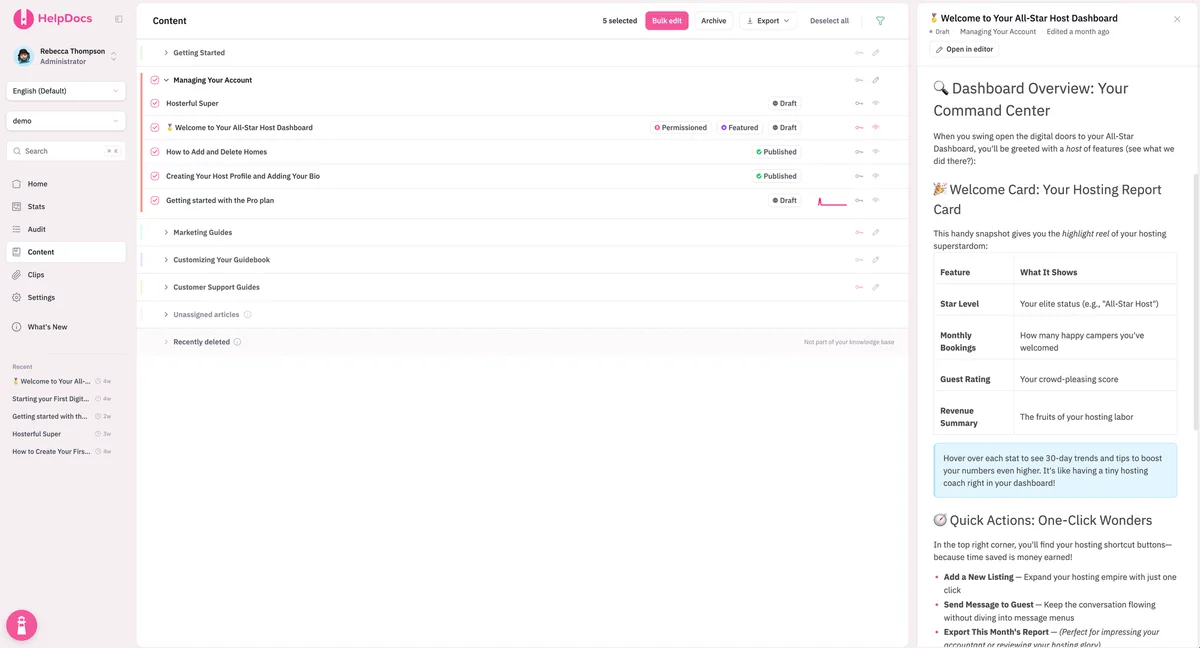
If you want to see what a grounded, answer-first setup looks like in practice, HelpDocs builds AI answers directly on top of your knowledge base, so the content you write is the content your customers get answered from.
The bottom line
AI knowledge management uses AI to do the parts of knowledge work that scale badly by hand: answering repeat questions, drafting and tidying content, organizing a growing library, and spotting the gaps in it. It doesn’t replace the discipline of writing clear, accurate articles. It amplifies whatever you feed it, for better or worse.
Start small and grounded. Pick one job, usually authoring or answering, keep the AI tied to your own content, and keep a human in the loop for everything it’s unsure about. From here, the rest of this chapter goes deeper: what an AI knowledge base is, how AI uses your knowledge base, AI for customer support, and the AI content improver.