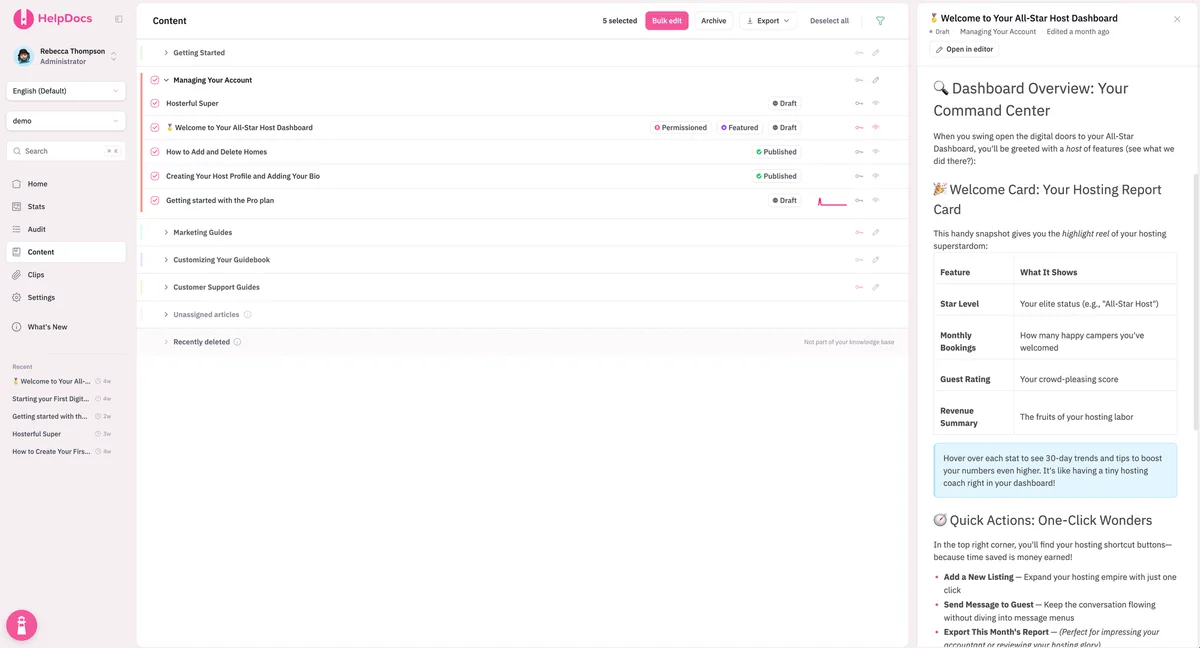
Enterprise knowledge management system
Scaling knowledge across teams: governance, permissions, and search.
The knowledge base that worked beautifully when you were ten people starts to creak at a thousand. Suddenly three teams have written three slightly different answers to the same question, nobody’s sure which one is current, and half the content is locked in a wiki only engineering can find. The articles are all there. The organization around them just stopped scaling.
That gap is exactly what an enterprise knowledge management system is built to close. It’s the tooling, the rules, and the ownership that let a large company capture what it knows and keep it findable, accurate, and secure as headcount and content both explode. It’s the grown-up version of everyday knowledge management, tuned for the messy reality of many teams, many audiences, and many opinions about who owns what. This guide walks the whole picture, then points you to the deeper operating playbooks.
What is an enterprise knowledge management system?
An enterprise knowledge management system is the combined platform and process a large organization uses to create, organize, govern, and surface knowledge across every team that needs it. That knowledge lives in two broad homes: the customer-facing knowledge base (your public help center) and the internal knowledge base your employees rely on to do their jobs.
At small scale, you can hold all of that in your head. At enterprise scale you can’t, and the cost of not writing it down is real. McKinsey’s research found knowledge workers spend close to a fifth of the workweek just hunting for internal information (McKinsey). Multiply that across thousands of employees and a good system pays for itself in recovered hours alone.
How is enterprise knowledge management different from a small team’s?
The principles don’t change. Write clearly, organize sensibly, keep things current. What changes is that every one of those tasks now involves coordination across people who don’t sit together and don’t always agree.
A solo support lead can just fix a wrong article. In a large org, that same fix might touch legal, product marketing, and two regional teams, and it needs to land in four languages without anyone overwriting anyone else. The difference is less about writing and more about governance and scale.
| Capability | Small team | Enterprise |
|---|---|---|
| Ownership | One person knows everything | Named owners per topic area |
| Access | Everyone can edit anything | Role-based permissions and approvals |
| Search | Browsing is usually enough | Search has to scale across thousands of docs |
| Accuracy | Fix it when you notice | Scheduled reviews and stale-content alerts |
| Audiences | One (customers or staff) | Many: regions, languages, roles, partners |
| Measurement | Gut feel | Dashboards, deflection metrics, search gaps |
Who owns knowledge in a large organization?
The single biggest failure mode at scale is that everyone assumes someone else is keeping the content honest. Assign clear ownership and most other problems shrink.
Give every topic area a named owner, a real person or team accountable for whether that content is accurate and current. Owners don’t have to write everything, but they sign off on it. A light governance model, spelling out who can publish, who reviews, and how often content gets checked, keeps a large knowledge base from drifting into a graveyard of half-true articles.
For the full operating rhythm behind this, our guide to knowledge management best practices covers the workflows, roles, and review cycles in depth.
How do permissions and access control work at scale?
Not everyone should see everything, and not everyone should edit everything. Those are two separate problems, and an enterprise knowledge management system handles both.
On the reading side, you’ll often run public content (your customer help center) alongside internal content that’s restricted by team, role, or region. Sensitive material, security runbooks, unreleased features, HR policy, needs access controls so it reaches the right people and no one else. On the writing side, role-based permissions decide who can draft, who can review, and who can hit publish, so a well-meaning intern can’t push an untested billing article live to millions.
Good access control is also what lets you keep one system instead of ten. Teams that can’t restrict content tend to spin up their own private tools, and fragmentation is how knowledge goes missing.
How do you make search work across a large knowledge base?
Once you pass a few hundred articles, browsing stops being enough. Search becomes the primary way people find answers, and at enterprise scale it has to work hard.
Search quality is worth obsessing over because the stakes are high. Harvard Business Review found that 81% of customers try to solve a problem themselves before contacting a human (Harvard Business Review), yet many of those attempts end with people searching and coming up empty. The fix is partly better content and partly smarter retrieval: consistent titles, good tagging, and AI-powered search that understands intent rather than matching exact words.
The searches that return nothing are pure gold, because they tell you precisely what your knowledge base is missing. Mining those empty queries is one of the highest-leverage habits an enterprise team can build, and we dig into it in dealing with no-result searches. Tuning what surfaces, and how, is exactly what a good search and self-service optimization layer is for.
Connecting your knowledge base to the tools teams already use
Knowledge that lives in a silo doesn’t scale. The value of an enterprise system comes largely from meeting people where they already work.
That means integrations: surfacing help articles inside your support tool, your chat platform, your in-app widget, and your AI agents, so nobody has to leave what they’re doing to go find an answer. When an article updates, that change should ripple everywhere it’s embedded, automatically. A knowledge base that syncs into a dozen touchpoints deflects far more tickets than one that makes people visit a separate website.
How do you keep content accurate across a large organization?
Content decays. Products change, policies update, and the article that was perfect last quarter quietly becomes wrong. At enterprise scale, decay is constant, so accuracy has to be a process rather than a one-time cleanup.
The mechanics are straightforward once they’re scheduled. Set review dates on articles, flag content that hasn’t been touched in a while, and give owners a clear queue of what to check. Retire duplicates ruthlessly, because two competing answers are often worse than one imperfect one. The full cadence, from audits to archiving, lives in our guide to keeping a knowledge base current.
How do you measure an enterprise knowledge management system?
You can’t improve what you don’t watch, and at scale the metrics also justify the investment to everyone writing the checks.
A few numbers tell most of the story:
- Ticket deflection. How many people find an answer instead of contacting support.
- Search success rate. The share of searches that lead to a useful article rather than a dead end.
- Article coverage. Whether your top question drivers actually have content.
- Content freshness. How much of your library is within its review window.
- Adoption. Whether employees and customers actually use the system versus routing around it.
Watch these over time, not once. Trends reveal whether your knowledge base is compounding in value or slowly falling behind the organization it serves.
The bottom line
An enterprise knowledge management system is what keeps a large company’s knowledge findable, trustworthy, and secure when there’s simply too much of it to manage by hand. The platform matters, but the governance around it matters more: clear owners, sensible permissions, search that works, integrations that spread knowledge everywhere, and a steady rhythm of review and measurement.
Start by naming owners and mapping what you have, then tighten one area at a time. When you’re ready to go deeper, work through the operating series: the best practices playbook, fixing failed searches, and ongoing maintenance. Each one turns a principle here into something you can actually run on Monday morning.