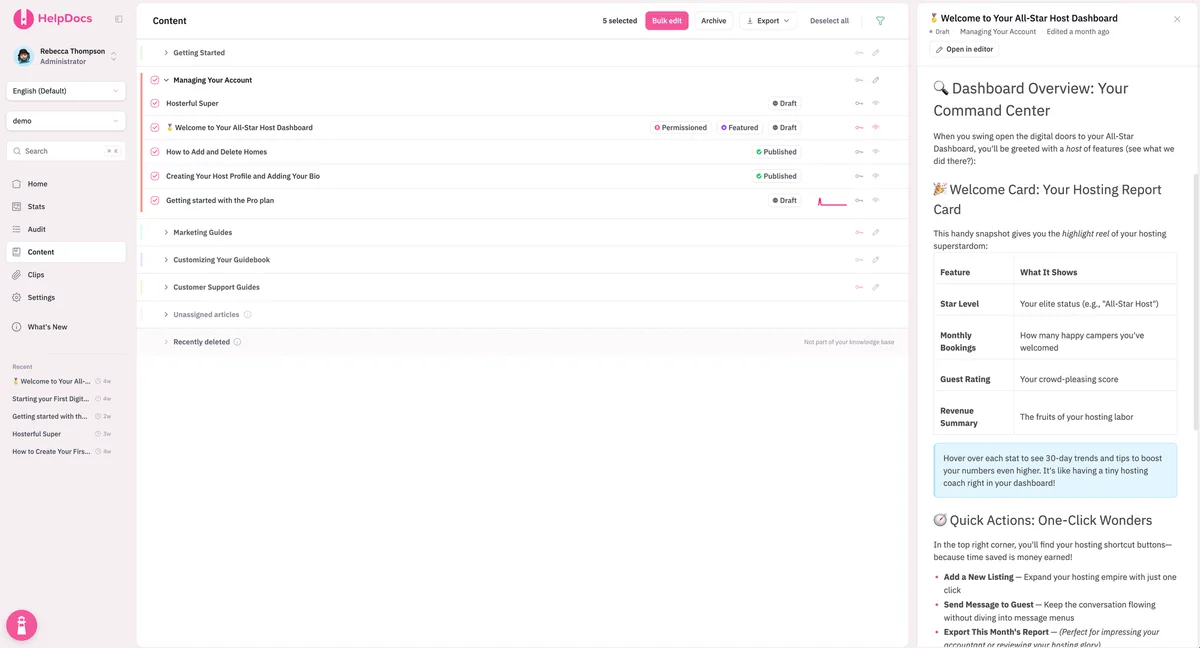
The benefits of a knowledge base
The support, sales, and onboarding payoffs of great self-serve docs.
Picture the last time you had a quick question about a product and just wanted the answer, not a chat window and a 20 minute wait. Your customers feel exactly the same, and closing that gap is where the benefits of a knowledge base start to add up. A good one (sometimes called a help center) answers questions before they ever reach your inbox, brings in traffic from people searching for solutions, and helps both customers and new hires get up to speed faster. It’s one of the few investments that pays off for support, sales, marketing, and your own team all at once.
Let’s walk through where those payoffs actually land, with real numbers where we have them.
Support benefits: fewer tickets, faster answers
The most immediate payoff shows up right in your support queue. Most customers would genuinely rather solve a problem themselves than open a ticket. Harvard Business Review found that around 81% of customers try to resolve an issue on their own before they reach out to a human, and that preference is even stronger for simple, everyday questions. When you don’t give them a place to do that, you’re forcing a conversation neither side asked for.
A few things happen once that content is in place:
- Ticket deflection. Every article that answers a common question is a ticket that never gets created. Companies with mature, well-maintained knowledge bases report meaningful drops in ticket volume, and every question answered before it becomes a ticket takes real cost out of your support budget (more on that math below).
- Faster resolutions. When a customer does reach out, your agents can drop a link to a detailed article instead of retyping the same explanation for the hundredth time. The answers stay consistent, there’s less back-and-forth, and everyone comes away happier.
- 24/7 availability. Your docs don’t sleep, don’t take holidays, and never sit in a queue. A customer in another timezone at 2am gets the same answer as one who emails during business hours.
The cost math is hard to argue with. Gartner pegs a live channel interaction (phone, chat, or email) at around $8, while a self-service interaction costs closer to $0.10. You don’t need many deflected tickets before your knowledge base has paid for itself several times over.
Sales and marketing benefits: traffic, trust, shorter cycles
One knowledge base benefit people often miss is that it doubles as a marketing asset. Your articles target the exact questions people type into Google, so they pull in organic search traffic from buyers who are actively evaluating tools like yours. That’s high-intent traffic you don’t have to pay a cent for.
It also builds trust. Modern B2B buyers do their homework long before they ever fill out a form. Gartner found that 61% of B2B buyers prefer a rep-free buying experience, and CEB’s research puts the typical buyer well past halfway through their decision before they contact a vendor at all. Thorough, public documentation quietly tells those buyers two things: the product is real and well-supported, and they won’t be left stranded after they sign up.
That kind of transparency tends to shorten sales cycles, too. When a prospect can read exactly how a feature works, see the integrations, and picture their own workflow, sales conversations start further down the funnel. Fewer “does it do X?” emails, more “we’ve read the docs, here’s our timeline.” Support and sales end up sharing the same content, which is a lovely bonus when you’re a small team wearing a lot of hats.
Onboarding benefits: faster ramp for customers and new hires
A knowledge base speeds up onboarding on both sides of the business, and that’s a benefit worth leaning into.
For customers, good getting-started guides can be the difference between activating in an afternoon and quietly drifting off in week two. The faster someone reaches their first “aha” moment, the more likely they are to stick around. Self-serve setup docs, checklists, and troubleshooting guides carry people through the riskiest part of their journey, no call booking required.
For your own team, those same docs pull double duty as internal training. New support hires learn the product by reading (and improving) the knowledge base instead of shadowing a senior teammate for weeks on end.
That matters, because ramp time is expensive. New hires can take the better part of a year to reach full productivity, and structured onboarding backed by solid documentation measurably shortens that ramp. Every answer that lives in an article is one a new hire doesn’t have to tap someone on the shoulder to get.
AI benefits: better grounding for assistants
This one has gone from “nice to have” to “central” in a hurry. AI support assistants and chatbots are only as good as the content behind them. When an AI assistant answers from your knowledge base, its replies are grounded in facts you wrote and can verify, which cuts down on those confident-but-wrong answers that quietly erode trust.
In practice, your knowledge base becomes the source of truth that powers automated answers across chat, search, and in-app help. Keep the articles accurate and well-structured, and your AI will be too. Let them go stale, and the AI just repeats your mistakes at scale.
The short version
A knowledge base (or help center) earns its keep in four places at once: it deflects tickets and cuts support costs, pulls in search traffic and builds buyer trust, ramps customers and new hires faster, and grounds your AI in real answers. Not many tools touch that many parts of a business.
Here are the benefits of a knowledge base side by side:
| Area | The payoff | Backed by |
|---|---|---|
| Support | Fewer tickets, faster resolutions, answers available 24/7 | About $8 per live channel contact vs ~$0.10 self-serve (Gartner) |
| Sales and marketing | Organic search traffic, buyer trust, shorter sales cycles | 61% of B2B buyers prefer a rep-free buying experience (Gartner) |
| Onboarding | Faster ramp for both customers and new hires | Structured, documented onboarding measurably shortens new-hire ramp |
| AI | Grounds assistants in accurate, verifiable answers | Only as good as the content behind them |
If you’d like a deeper primer on the fundamentals, the HelpDocs blog has a great breakdown of what a knowledge base is. Otherwise, the benefits above are reason enough to start writing.