Best Online Knowledge Base Software (2026)
Almost nobody self-hosts a help center any more, so "online" is the default rather than a feature. This compares nine hosted platforms on what actually differs: custom domains and SSL, page speed and SEO, published uptime, and how you'd get your content out.
Almost nobody self-hosts a help center any more. That makes “online knowledge base software” a description of the entire market in 2026 rather than a feature you shop for, and it quietly moves the real decision somewhere less obvious. You aren’t choosing whether the thing is hosted. You’re choosing who runs it, whose domain it answers on, and how hard it would be to leave.
So this roundup compares nine hosted platforms on the operational questions: custom domains and SSL, how the published pages behave in search, whether uptime is something you can check, and what your content looks like on the way out. If you want the category from the top first, our guide to knowledge base software covers what these tools actually do, and the wider best knowledge base software roundup ranks twelve of them without the hosting lens.
We make HelpDocs (hey! 👋), so we might be a little biased. We’ve tried to be as honest as possible anyway, including about where we’re the wrong answer.
What “online” actually buys you
Five things, and they’re worth separating, because vendors bundle them very differently.
Servers you never touch. No provisioning, no patching, no upgrade weekend, no 2 a.m. page when a disk fills up. This is what everyone means by “online”, and every tool below does it, so it almost never decides anything.
A custom domain with a working certificate. Your help center should answer on help.yourcompany.com over HTTPS, not on a vendor subdomain with someone else’s brand in the URL. That sounds like table stakes and isn’t, because on several tools here the domain is gated behind a specific plan or sold separately. Price the plan that includes it, not the one on the left of the pricing page.
Pages that are fast and indexable. For most companies the help center is the second-most-read thing they publish, so the vendor’s templates decide how much search traffic your articles earn. Worth asking: what does the stock template score in PageSpeed, are sitemap.xml and robots.txt generated for you, and can you edit slugs and meta descriptions per article. Help center design goes further into the reader-facing side of that.
Uptime you can verify. When the help center is down the tickets arrive anyway, usually about the thing the help center would have answered. A public status page and a stated SLA turn reliability from a sales promise into something you can check on a Tuesday morning.
A way out. Hosted means the database is theirs, so the export path matters more than it does with software you run yourself. Look for a documented export format or a read API before you commit, plus redirect management, because moving domains without redirects throws away every ranking your articles earned.
How we evaluated these
We weighted the things that only show up after you’ve signed, rather than the things a demo shows well.
Where the hosting essentials live. A custom domain, SSL, and the ability to strip or keep vendor branding, and specifically which plan each of those arrives on. This is the single biggest source of surprise between a shortlist and an invoice.
What the published site does for search. Generated sitemaps, editable metadata, clean slugs, redirect handling, and template performance. A hosted help center that loads slowly and can’t set a meta description is a hosted help center that doesn’t earn traffic.
How much operational risk you’re taking on. Published uptime, a status page, encryption, and where the vendor is in its compliance program. Also whether the tool can be run at all without infrastructure of your own, since two tools here expect a build step or a desktop install.
What happens if you leave. Export formats, read APIs, and whether your content is stored in something portable like Markdown. Tools with real importers coming in usually have sane ways out.
The shape of the bill. Flat, per agent, per seat, per member, per site, or per resolution. All five behave differently as your team and your readership grow, and the readership half matters most for a public help center.
Two things we didn’t score: homepage logo counts, and vendor-reported satisfaction figures.
The 9 best online knowledge base tools in 2026
The whole field at a glance, with the two columns that get overlooked most often.
| Tool | Best for | Starting price | Custom domain | Content export |
|---|---|---|---|---|
| HelpDocs | A hosted help center on your own domain | $129/mo | Included on every plan, with SSL | Read/write REST API and MCP |
| Document360 | Hosted docs with a formal review trail | Quote only | Yes | Markdown, PDF, and API |
| Helpjuice | Handing the theming and the move to the vendor | $249/mo | Yes | PDF, DOCX, HTML, plus CSV and a backup ZIP |
| KnowledgeOwl | Hosted docs with tightly controlled reader access | $100/mo | On Pro, $250/mo | PDF export, plus a public API on Pro |
| Zendesk Knowledge | A help center inside a support suite | $55/agent/mo | Yes, via host mapping | Yes, through the Zendesk API |
| Intercom | Hosted docs that feed an AI agent | $29/seat/mo | Yes | Yes, through the Intercom API |
| GitBook | Publishing docs straight from a Git repo | $0, then $65/site/mo | From the Premium plan | Markdown, in the repo you sync |
| Notion | Getting something public this afternoon | $0, then $10/seat/mo | Paid Sites add-on, about $8/mo per domain | Markdown and HTML export, plus API |
| Slite | Hosted internal docs for colleagues | $0, then $10/member/mo | On Pro, $20/member/mo | Markdown export, plus API and MCP |
Best for a hosted help center on your own domain: HelpDocs
We make HelpDocs (hey! 👋), so read this with the appropriate skepticism, and check anything that matters against the pricing page. The hosting posture is the simple part: there’s nothing to install, a custom domain with SSL is included on every plan rather than gated or sold separately, and new features arrive without an upgrade you have to schedule.
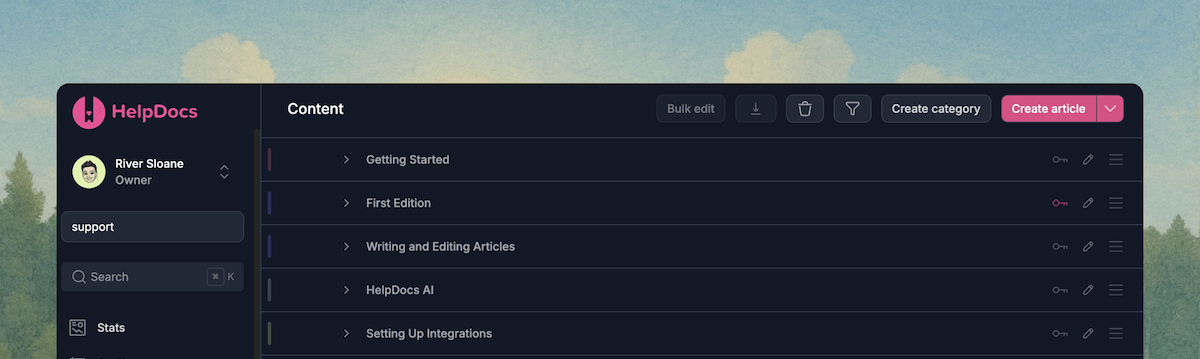
The published site is where we’ve put the effort. The V5 templates score 100/100 for SEO and accessibility in PageSpeed, and sitemap.xml, robots.txt, and llms.txt are generated for you, that last one for AI crawlers. Redirect management is built in with bulk editing and validation, plus slug-change detection so renaming an article doesn’t silently break the link somebody bookmarked. There’s also a .dev staging mode, so you can redesign the help center before promoting it to the live domain.
On the operational side we publish a 99.9% uptime SLA and a public status page at status.helpdocs.io, content is encrypted in transit and at rest, and we’re GDPR compliant. Pricing is flat and published: $129/mo on Sprout for 5 editors, $299/mo on Bloom for 15, $499/mo on Harvest for 25, with 20 percent off annually. Public readers are unlimited and free, which is the part that matters for a hosted site whose whole job is being read by more people than last month.
Pros
- Custom domain plus SSL on every plan, with a 99.9% uptime SLA and a public status page at status.helpdocs.io, so hosting reliability is checkable rather than asserted.
- The published site is built to be found: 100/100 PageSpeed SEO and accessibility on V5 templates, generated sitemap, robots.txt and llms.txt, editable slugs and meta descriptions, and bulk redirect management with slug-change detection.
- Flat pricing with unlimited free public readers, so traffic growth never arrives as a bigger invoice, and a
.devstaging mode for reworking the design before it goes live on your domain.
Cons
- There’s no self-hosted or on-premise option and no single-tenant hosting tier. If a data residency rule says the content has to sit in infrastructure you control, we’re the wrong purchase and Document360’s Enterprise+ dedicated hosting is a more sensible conversation.
- SOC 2 Type II and ISO 27001 audits are in progress rather than finished, with completion expected around November 2026. If your security review needs a current report today, that’s a real blocker.
- Getting content out means the read/write REST API (or MCP), not a one-click archive download, and there are no general-purpose outbound webhooks, only We integrate with SlackSlack webhooks for publish, feedback, and team events. So you can’t push a publish event into your own pipeline.
- There’s no free tier, only a 14-day trial with no card, and no option to remove the HelpDocs mark or run multiple branded help centers from one account.

Starting price: $129/mo flat (Sprout, 5 editors), or $99/mo billed annually Best for: Teams who want the help center itself to be the product, on their own domain, at a price that doesn’t move when readership does.
Best for hosted docs with a formal review trail: Document360
Document360 treats documentation as an engineering artifact, and it’s the tool here with the most deliberate answer to “where exactly does our content live”. Dedicated hosting is available on its Enterprise+ tier, projects and workspaces are separate so one organization can run several distinct docs sites with their own structure and permissions, and full white-labeling is available on higher tiers. If a procurement questionnaire is part of your buying process, that combination is the reason this one usually survives it.
The authoring side is genuinely deep: version history with side-by-side diffs, a configurable multi-step approval workflow that can hold an article until the named reviewer signs off, a Category Manager built for deeply nested trees, and native OpenAPI and Swagger reference rendering. Content reuse and glossary tooling are more built out than most help center tools bother with. Getting content out is a solved problem too, with Markdown and PDF export plus an API.
The commercial shape is the hard part. As of July 2026 pricing is quote-only and charged per project, which means one knowledge base, so a second docs site is a second negotiation. Third parties report roughly $199 to $249/mo for Professional, $399 to $499/mo for Business, and $799+/mo for Enterprise, though those are reported quote ranges rather than list prices.
Pros
- Dedicated hosting on Enterprise+, plus separate projects and workspaces, so several docs sites can run with their own structure, permissions, and branding.
- Version history, diffs, and a multi-step approval workflow, which is what regulated and audited documentation teams actually buy it for.
- Portable on the way out: Markdown and PDF export plus an API, so your content isn’t locked in a proprietary store. Native OpenAPI and Swagger rendering means an API reference can live in the same product.
Cons
- You can’t find out what it costs. Quote-only pricing charged per project means evaluating it takes a sales conversation, and running a second knowledge base takes another one.
- Its Ask Eddy AI is a paid add-on on top of the base subscription, reportedly adding roughly 30 to 50 percent, so the number you negotiate isn’t the number you pay. HelpDocs vs Document360 has the detail.
Starting price: Quote only (per project, billed annually) Best for: Documentation teams whose content gets versioned, approved, or audited, and who need hosting arrangements a security review will accept.
Best for handing the theming and the move to the vendor: Helpjuice
Helpjuice’s pitch is that you get the finished help center rather than the toolkit. Their team hand-skins the site as part of onboarding, and they’ll run your content migration as a service with free migration hours, redirects and re-uploaded images included. For a team without a designer or a spare week, that’s a real offer, and worth pricing against what a designer plus a migration week would actually cost you.
Underneath that, the customization goes further than most. You get the theme files, plural: HTML, CSS, JavaScript, and Liquid templates, editable per language, with a visual editor for people who want none of that. Localization and AI article translation are on every tier including the cheapest, which is genuinely unusual, since multilingual is normally the lever vendors pull to move you up a plan.
Read the plan structure before you compare headline prices, because the entry plan is pitched at a smaller team that wants the theming rather than the AI. The $249/mo entry plan gets you 30 logins with no SSO and no AI features at all, AI search and the chatbot start at $449/mo, and unlimited logins is $799/mo. Only monthly pricing is published, with no annual discount shown anywhere, and there’s a 14-day trial with no card but no free tier to fall back on.

Pros
- Done-for-you setup: the vendor hand-skins your help center during onboarding and will run the migration as a service, including redirects and re-uploading images, which removes the riskiest part of moving hosts.
- Full theme file access per language (HTML, CSS, JavaScript, Liquid), so the published site can be exactly what a designer drew rather than what a theme allows.
- Localization and AI article translation on every tier, including the entry plan, so a multilingual help center isn’t a second upgrade.
Cons
- The entry plan is aimed at a smaller team that wants the theming rather than the AI, so price the tier you need rather than the headline: $249/mo covers 30 logins with no SSO and no AI at all, AI search or the chatbot means $449/mo, roughly an 80 percent step up, and unlimited logins is $799/mo.
- Monthly pricing only, with no published annual discount and no free tier under the 14-day trial. There’s also no OpenAPI or Swagger rendering, so an API reference has to live somewhere else.
Starting price: $249/mo flat (30 logins, no SSO, no AI) Best for: Brand-led teams in several languages who’d rather hand the theming and the migration to the vendor than own either.
Best for hosted docs with tightly controlled reader access: KnowledgeOwl
KnowledgeOwl is a hosted knowledge base that has been doing that one job for years, and its distinguishing feature is who’s allowed to read what. Reader groups control access at the article and category level, so a single hosted site can carry a public help center, a partner area, and internal-only pages instead of splitting into separate properties. Readers are unlimited and free on every plan, so the audience half of the bill sits still while traffic grows.
On the hosting essentials, a custom domain arrives on the Pro plan, and the same tier brings the public API, webhooks, and full HTML, CSS, and JavaScript theme access, so the published site can be hand-built rather than limited to what a theme picker allows. Every plan includes white-glove migration help and recurring 1:1 onboarding calls, which takes the riskiest part of changing hosts off your desk. Search analytics report the queries that returned nothing, and semantic search handles synonyms and vaguely worded questions.
Pricing is flat per plan with one author included: $100/mo on Basic, $250/mo on Pro, $500/mo on Business, and a quote for Enterprise. Extra authors are $25/mo each, each additional knowledge base is $50/mo, and SAML or Salesforce SSO plus a HIPAA BAA sit on Business. On the way out there’s PDF export alongside the public API and webhooks from Pro up. AI is included but metered by monthly credits that don’t roll over, from 25 a month on Basic to 250 on Business.
Pros
- Reader groups gate access down to individual articles and categories, so one hosted site can serve customers, partners, and staff instead of three.
- Unlimited free readers on every plan, plus white-glove migration and recurring 1:1 onboarding calls included, so changing hosts is a supported project rather than a solo one.
- Full HTML, CSS, and JavaScript theme access from Pro up, with a public API and webhooks alongside it and PDF export for anything that needs to leave the platform.
Cons
- The custom domain starts on Pro at $250/mo, so on the $100/mo Basic plan your help center answers on a KnowledgeOwl subdomain, and the API and theme code access sit on that same tier.
- The bill has several multipliers to model: one author included with extras at $25/mo each, $50/mo for every additional knowledge base, and SSO plus the HIPAA BAA only on the $500/mo Business plan. HelpDocs vs KnowledgeOwl has the detail.
Starting price: $100/mo on Basic (1 author, extra authors $25/mo each), with the custom domain, API, and theme code access on Pro at $250/mo Best for: Teams who need one hosted site to show different content to customers, partners, and staff, with a 30-day trial and no card to test it on.
Best for a help center inside a support suite: Zendesk Knowledge
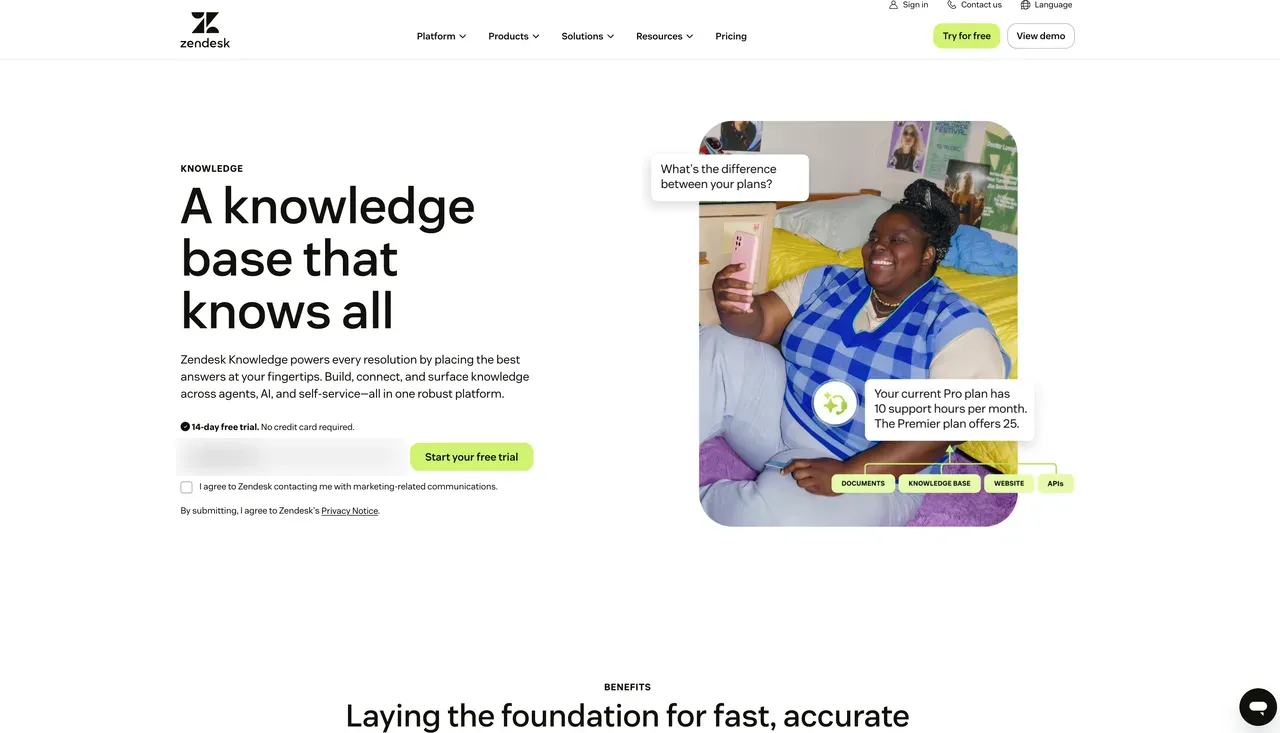
Zendesk Knowledge is the help center module bundled inside Zendesk Suite, the product Zendesk used to call Guide. It isn’t sold on its own, which tells you who it suits: teams already running their support operation on Zendesk ticketing who want the docs hosted in the same place, under the same login, on the same bill.
At scale it earns that. Host mapping puts the help center on your own domain, Curlybars templating gives full HTML control over the published site, and multi-brand help centers arrive from Suite Growth at $89/agent/mo, so several products or regions can each get their own branded site from one account. Explore reporting covers search dashboards, automated resolutions, deflection, and contributor activity across the whole operation rather than just the knowledge base. Very little else does all of that as thoroughly.
The cost shape is per agent, and it stacks. Suite Team is $55/agent/mo billed annually, rising to $89 on Growth and $115 on Professional, the Advanced AI (Copilot) add-on is roughly another $50/agent/mo, and automated AI resolutions are metered once you pass a small free allowance. A ten-agent team on Professional is about $1,150/mo in seats before any add-on.
Pros
- Curlybars theming gives full HTML template control over the hosted help center, and host mapping puts it on your own domain.
- Multi-brand help centers from Suite Growth up, so several branded sites can run from one account and one bill.
- Explore reports search, automated resolutions, deflection, and contributor activity, so you can see how the published site is performing rather than guessing.
Cons
- You pay per agent for the whole suite whether anyone touches ticketing or not: $55 to $115/agent/mo, plus roughly $50/agent/mo for Advanced AI and metered resolutions on top. That’s an expensive way to buy hosting for a help center if the help center is all you want.
- Branding controls are limited, and removing the “Powered by Zendesk” mark needs a higher plan. Knowledge is a module rather than a product in its own right, so it gets the roadmap attention a bundled feature gets. HelpDocs vs Zendesk has the detail.
Starting price: $55/agent/mo (Suite Team, billed annually), plus roughly $50/agent/mo for the Advanced AI add-on Best for: Large support orgs already running omnichannel ticketing on Zendesk who want the hosted help center inside the same suite.
Best for hosted docs that feed an AI agent: Intercom
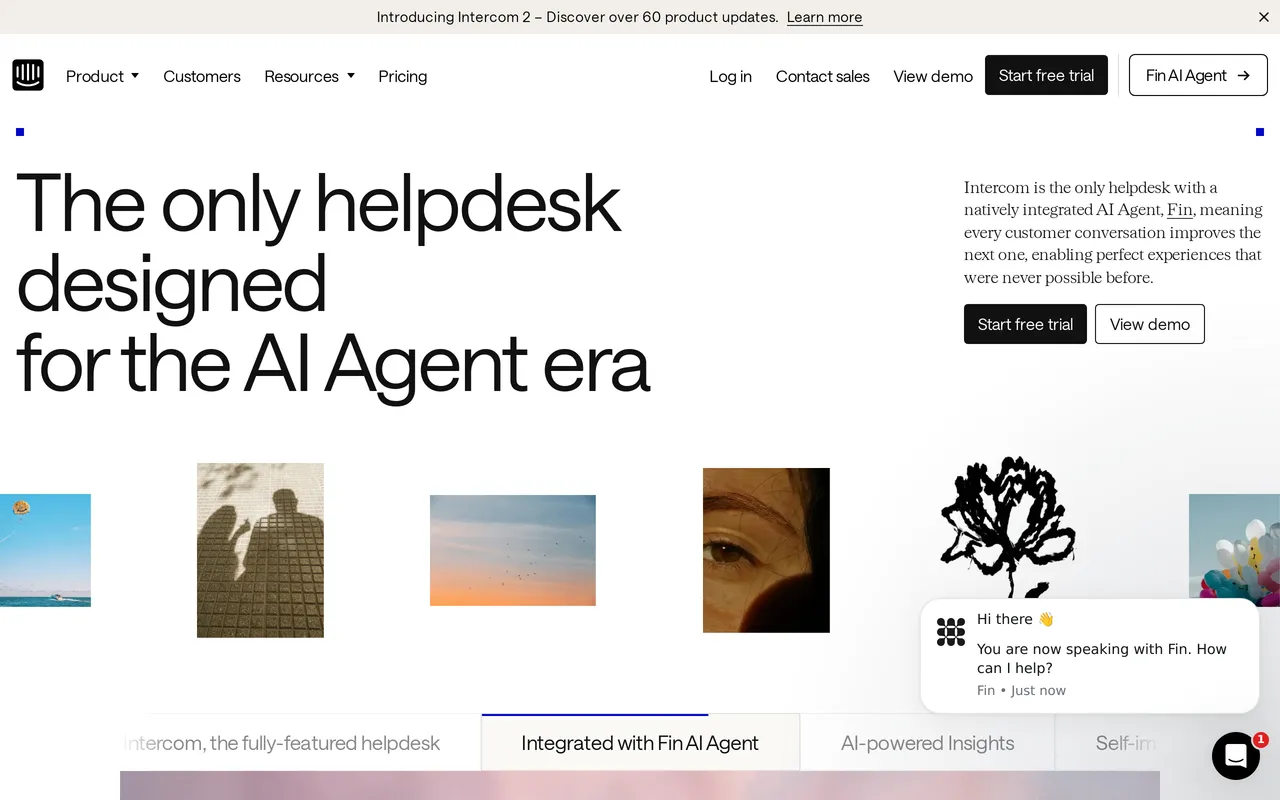
Intercom’s knowledge base is called Articles, and it increasingly exists to feed We integrate with FinFin, We integrate with IntercomIntercom’s AI agent. That’s a coherent strategy rather than neglect, and it’s the reason to pick Intercom. If your plan for reducing ticket volume is an agent handling conversations end to end rather than readers finding articles and going away satisfied, Fin is the most complete version of that idea you can buy today.


The hosted side is solid and tightly integrated. Articles publishes on your own custom domain, there are 45 languages, private and multilingual Help Centers arrive on Advanced, and multi-brand Help Centers on Expert. The Messenger, Articles, and Fin behave like one system rather than three products with integrations bolted between them, which is rarer than vendors make it sound. Articles is also separable enough that you can lift the content out through the API and leave the Messenger exactly where it is.
Pricing has two dials and you only control one. Seats are $29/seat/mo on Essential, $85 on Advanced, and $132 on Expert billed annually, and Fin bills separately at $0.99 per resolution with a 50-resolution monthly minimum. A month where deflection works beautifully is also a month with a bigger invoice.
Pros
- The published Help Center, the Messenger, and Fin share one content source, so in-product help, chat, and the AI agent stay consistent on your own domain.
- 45 languages, with private and multilingual Help Centers on Advanced and multi-brand Help Centers on Expert.
- Fin resolves live chat and ticket conversations end to end, which is a different and more ambitious job than answering questions on a docs page.
Cons
- Per-seat pricing plus $0.99 per Fin resolution means the bill moves with conversation volume you don’t control, and multi-brand Help Centers sit on Expert at $132/seat/mo.
- Articles is the feedstock rather than the product, so category management, theming, and failed-search reporting are lighter than in tools whose whole roadmap points at the help center. HelpDocs vs Intercom has the detail.
Starting price: $29/seat/mo (Essential, billed annually), plus $0.99 per Fin resolution Best for: Teams betting on an AI agent as the support front line who can model their conversation volume before they sign.
Best for publishing docs straight from a Git repo: GitBook
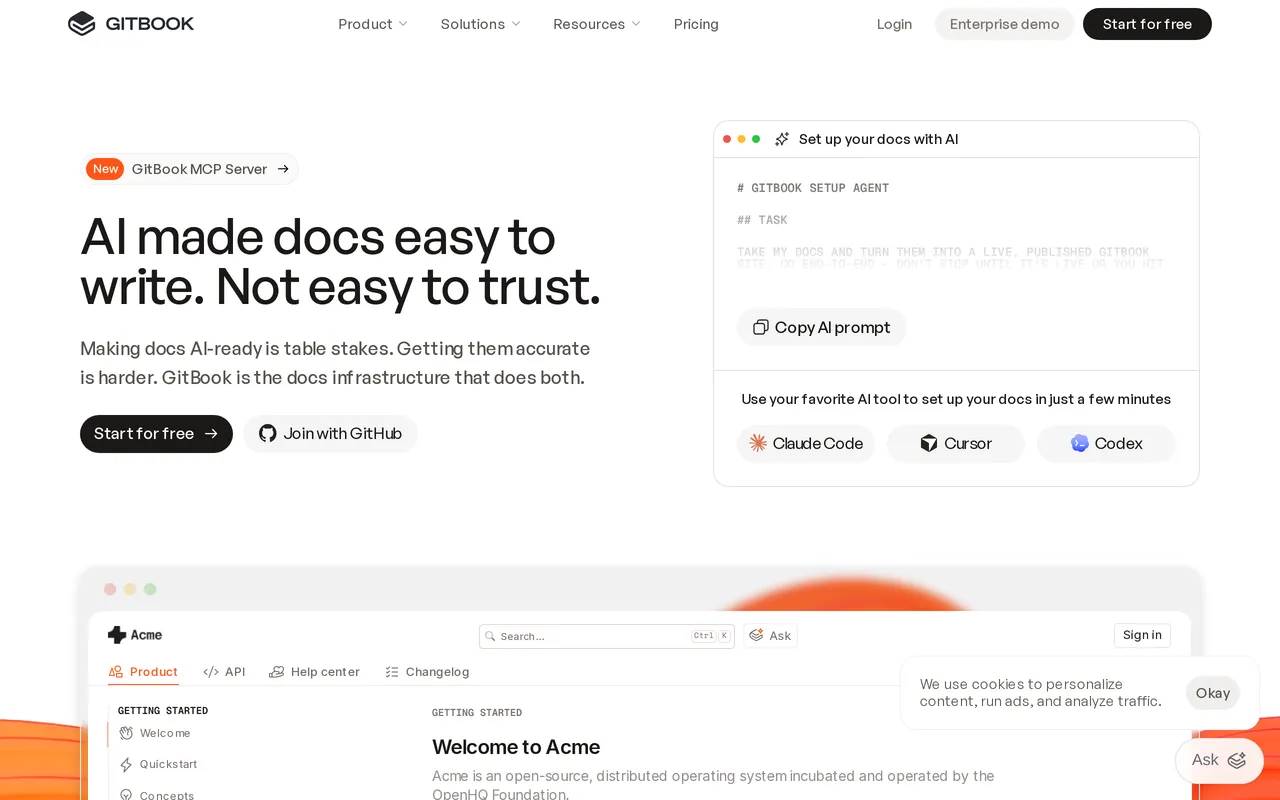
GitBook is a documentation platform built around a Git workflow, and if that’s how your team already works, very little else here fits as neatly. Docs sync with GitHub and GitLab so they’re versioned alongside the codebase, editing is Markdown-first, and changes go through branching and change requests that map onto release versions. It imports OpenAPI and Swagger and renders interactive API references that update themselves, so the reference never drifts from the code it documents.
It’s also the easiest platform here to leave, which is to its credit. Content is stored as Markdown, so you either export it or pull it straight out of the repo you’re already syncing with. Nothing sits in a proprietary format you have to negotiate your way out of.
Two things to weigh on the hosting side. Publishing runs through a repo and a sync, which is a real barrier for a non-technical author who just needs to fix one wrong sentence today. And billing is per documentation site: Premium is $65/site/mo plus $12/user/mo, with the custom domain arriving on Premium rather than Free, and the AI Assistant, AI Insights, and authenticated access unlocking on Ultimate at $249/site/mo plus the same per-user charge. Running developer docs and a separate customer help center means paying that twice.
Pros
- Git sync with GitHub and GitLab, Markdown-first editing, and change requests that behave like pull requests, so docs ship on the same review process as code.
- The most portable content on this list: Markdown you already hold in your own repo, so leaving is an export rather than a project.
- OpenAPI and Swagger import with auto-updated interactive references, plus a real free plan for one user so you can test it on an actual repo first.
Cons
- The Git workflow is a barrier for non-technical authors. Fixing a sentence means a branch, a change request, and an engineer who’s in the middle of something else, which is how a help center goes stale.
- Per-site billing adds up: $65/site/mo plus $12/user/mo on Premium, where the custom domain also starts, and $249/site/mo on Ultimate for AI and authenticated access. Lower tiers show a “Made with GitBook” badge. HelpDocs vs GitBook has the detail.
Starting price: $0/site/mo for one user, then $65/site/mo plus $12/user/mo on Premium Best for: Engineering teams whose documentation belongs in the repo, written by people who want Markdown and pull requests.
Best for getting something public this afternoon: Notion
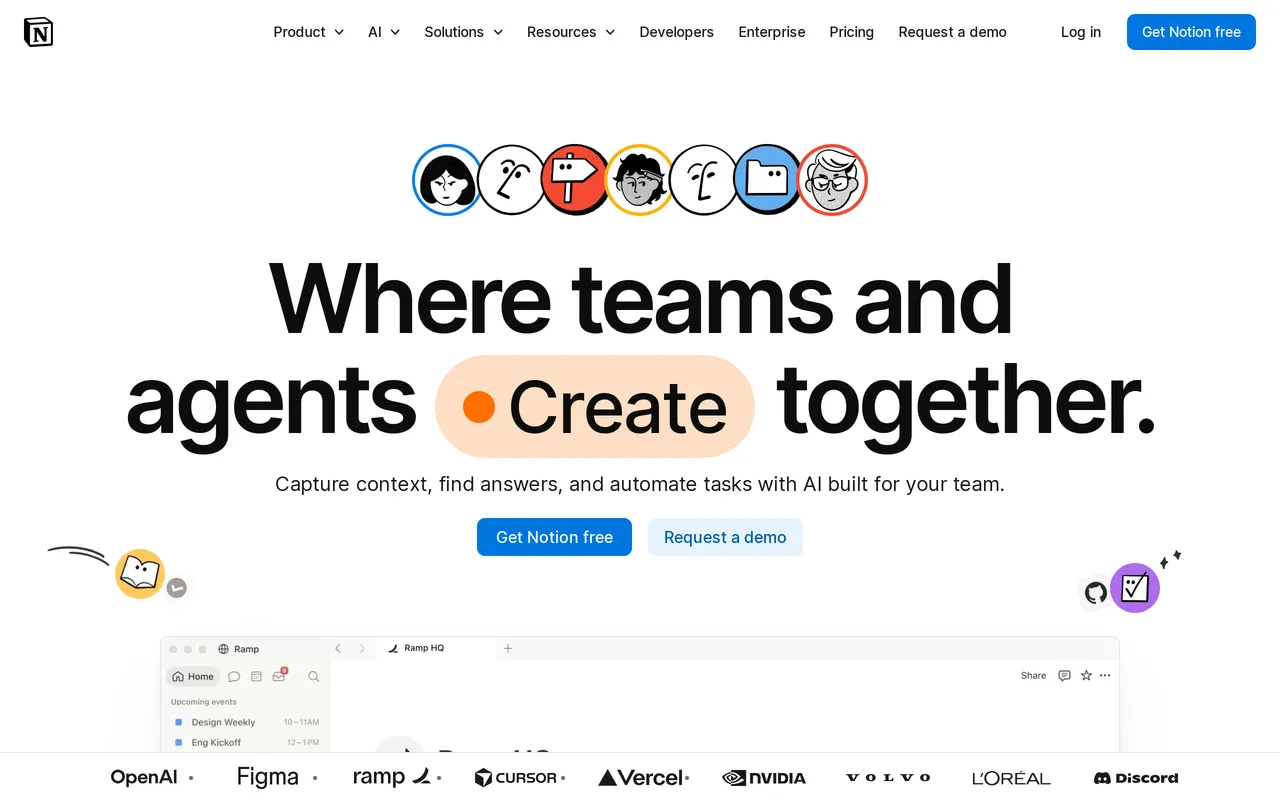
If your team already writes in Notion, publishing what’s there is the fastest route on this list to getting documentation in front of customers, and for a ten-person company that’s very often the correct call. There’s no migration project because there’s nothing to migrate, no onboarding call, and nothing new for anyone to learn. The block editor is excellent, the free plan is real rather than a trap, and a Notion Site can be live in an afternoon.
Be clear-eyed about what you’re shipping, though. A wiki page customers can read is a different product from a help center, and the published-site controls are thin: no custom CSS, no custom JavaScript, no control of the underlying HTML template, basic search, and no failed-search reporting or SEO helpers. Removing the “Made with Notion” badge needs a paid Sites plan, and publishing on your own domain is a Notion Sites add-on at roughly $8/mo per domain on top of seats.
Getting out is easy at least: pages export as Markdown or HTML, and there’s a public API with webhooks. Pricing is $0 on Free, $10/seat/mo on Plus, and $20/seat/mo on Business billed annually, where full Notion AI and SAML SSO unlock.
Pros
- Nothing to migrate and nothing to learn if your docs already live there, so a public site can be online the same day.
- A genuinely usable free plan, then low per-seat pricing, which makes it the cheapest way here to publish something public.
- Clean exit: Markdown and HTML export plus a public API and webhooks, so content and automation both have a route out.
Cons
- A custom domain is a paid Sites add-on at roughly $8/mo per domain rather than part of the plan, and removing the Notion badge needs a paid Sites plan too.
- The published site gives you little control: no custom CSS or JavaScript, no HTML template access, basic search, and no failed-search reporting or SEO tooling, so you won’t learn what readers couldn’t find. HelpDocs vs Notion has the detail.
Starting price: $0, then $10/seat/mo on Plus, billed annually, plus about $8/mo for a custom domain Best for: Early-stage teams whose docs already live in Notion and who don’t have a content problem yet.
Best for hosted internal docs for colleagues: Slite
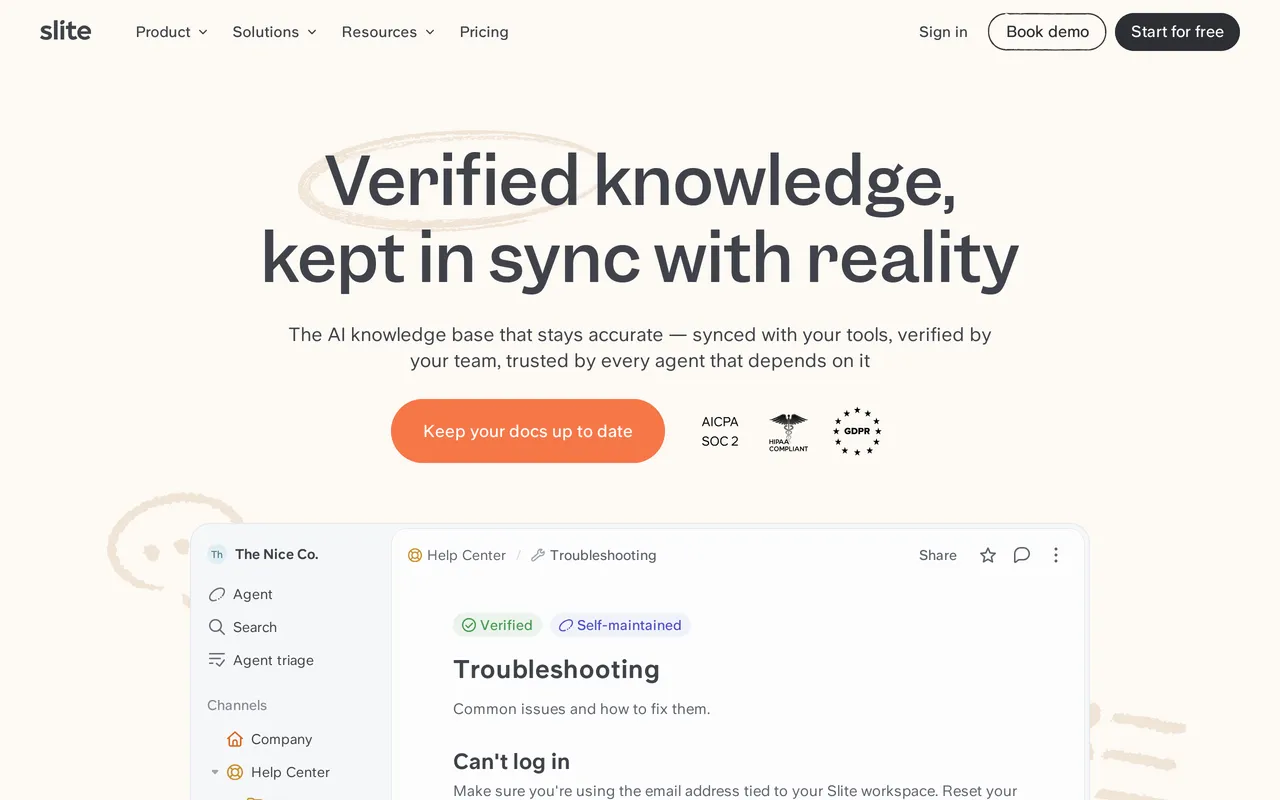
Slite is a team wiki, and a nicer one than most. It’s fast, clean, and genuinely pleasant to write in, which matters more than it sounds when you’re trying to get a whole team to document anything. Setup is close to nothing: a free plan, then $10/member/mo on Basic billed annually, with very little to configure.
The AI is pointed at upkeep as much as search. Ask answers questions from your internal docs and, on Pro, reaches across 12+ connected tools like Slack, Jira, and Linear, while the Slite Agent flags pages that have drifted out of date and drafts an update. Doc verification, where a page gets marked verified and someone gets prompted when it goes stale, is a smarter answer to knowledge rot than most tools manage. There’s a public API and MCP access, and documents export as Markdown.
The shape to check is who’s reading. Billing is per member, so readers cost money, which is fine while the audience is your team and the wrong shape entirely for a public help center. Publishing public docs on a custom domain only arrives on Pro at $20/member/mo, Basic caps Ask at roughly 30 questions per seat per month, and there’s no failed-search reporting, no custom CSS or HTML templating, and no SEO helpers.
Pros
- Cheap and quick to get running: a real free plan, then $10/member/mo, with an editor teams enjoy and almost no configuration.
- Doc verification plus the Slite Agent chase stale content actively, which is the maintenance problem most tools ignore.
- Ask on Pro searches Slack, Jira, and Linear alongside your docs, and content exports as Markdown with an API and MCP access behind it.
Cons
- Per-member billing means every reader costs money, which is the wrong economics for a public help center whose whole purpose is more readers.
- The public help center layer is thin: a custom domain only on Pro at $20/member/mo, no custom CSS or HTML templating, no SEO helpers, and no failed-search reporting. HelpDocs vs Slite has the detail.
Starting price: $0 on Free, then $10/member/mo on Basic (billed annually) Best for: Small and mid-size teams documenting internal processes, onboarding, and runbooks for colleagues rather than customers.
When “online” still means a project
Two of the tools above only look fully hosted from a distance, and it’s worth naming that as a cost rather than a flaw.
GitBook hosts the published site, but your publishing path runs through a repo and a sync. That’s excellent when engineers own the docs and awkward when a support agent needs to correct a price on a Friday. The cost isn’t money, it’s the number of people in your company who can safely change a page.
MadCap Flare sits further along the same line and doesn’t appear in the list for that reason. Flare Desktop is a Windows application published at $3,150 per author per year, you build your output locally, and all three Flare Online tiers say Contact Sales. It’s a genuinely strong tool for structured technical authoring, condition tags, single-sourcing, and print output, and it’s not what anyone means by online knowledge base software.
The general rule: if publishing a one-word fix requires software installed on a particular machine, or a build that somebody has to run, then the hosting is only half done.
What to check before you sign
Five checks, in the order that saves the most pain.
Which plan the domain is on. Then re-run your price comparison. A tool that looks $60/mo cheaper stops being cheaper once the custom domain, the branding removal, and SSO are all one tier up.
What the published pages score. Put a vendor’s own demo help center through PageSpeed and look at the source. Check whether a sitemap is generated, whether you can set a slug and a meta description per article, and whether the templates are accessible. This takes ten minutes and predicts a year of organic traffic.
Where the uptime lives. Ask for the status page URL and the SLA number. A vendor with neither isn’t necessarily unreliable, but you’re taking reliability entirely on trust, and your help center is the page people go to when something’s already broken.
How you’d leave. Ask for the export format in writing before you buy, not after. Markdown or HTML export, or a documented read API, is the difference between a migration and a retyping exercise.
What happens to your URLs. Redirect management is the least glamorous feature in this whole category and the one whose absence costs the most. If you’re moving from an existing help center, map old URLs to new ones before you switch the domain, or you’ll donate every ranking those pages earned back to the search results. How to build a knowledge base covers the sequencing.
So which should you pick?
Compressed, so you can stop reading.
Pick HelpDocs if you want a hosted help center on your own domain with SSL, a fast indexable published site, and a bill that doesn’t move when readership grows. Pick Document360 if hosting arrangements, versioning, or a formal approval trail have to satisfy a security review. Pick KnowledgeOwl if different readers need to see different articles, and the Pro tier that unlocks a custom domain is comfortable.
Pick Helpjuice if you’d rather the vendor did the theming and the migration for you. Pick Zendesk Knowledge if your support operation already runs on Zendesk and you want the docs in the same suite.
Pick Intercom if the plan is an AI agent on the front line rather than readers finding articles. Pick GitBook if your docs belong in the repo and your authors are engineers. Pick Notion if you need something public today and don’t have a content problem yet. Pick Slite if the readers are colleagues and the job is keeping internal docs current.
And the honest case against us, since a roundup without one is just an advert. If you need the content to sit in infrastructure you control, or a completed SOC 2 report today rather than around November 2026, HelpDocs is the wrong answer. If you need ticketing, live chat, a free forever plan, multi-brand help centers, or your logo where ours is, several tools above do those things and we don’t. We’d rather you found that out here than in month two.
Still weighing it up? Start a free trial and point a test subdomain at it, or check what it costs first.