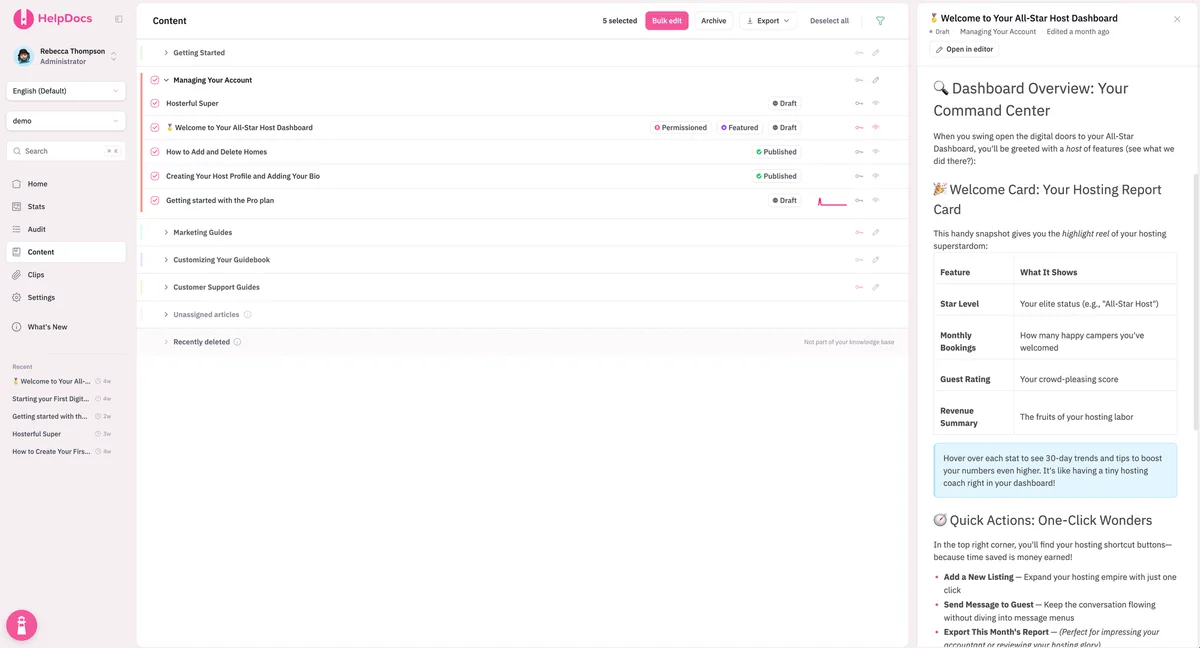
A content maintenance workflow
Keep articles fresh with a repeatable review cadence.
You open your own knowledge base to send a customer a link, and there it is. A screenshot from two redesigns ago, a price that changed last spring, a button that doesn’t exist anymore. Nobody flagged it. It just quietly went stale while you were busy shipping everything else.
That’s the catch with knowledge base maintenance. Writing an article feels like the finish line, but publishing is really the starting gun. Every article you own is a small promise to keep it true, and a repeatable content maintenance workflow is how you keep that promise without living inside your help center. It’s one of the daily habits behind a healthy enterprise knowledge management system, and it’s far less painful than the once-a-year panic audit most teams fall back on.
Why knowledge base maintenance matters
Stale content is arguably worse than no content, because it burns trust at the exact moment someone needs you. Roughly 81% of customers try to resolve an issue on their own before reaching out to a live rep, according to research popularized by Harvard Business Review. When one of those people lands on a wrong answer, you’ve spent their goodwill and still earned the ticket.
The scale of the gap is easy to underestimate. A large share of self-service attempts never fully resolve the customer’s issue, and thin, outdated, or hard-to-search content is a big part of why. Good maintenance is how you keep the content working long after the excitement of writing it wears off.
Set a review cadence for every article
Not every article deserves the same attention, so trying to review all of them on the same schedule is how maintenance stalls. Cadence should follow two things: how much traffic an article gets and how fast the underlying topic changes. Your billing and onboarding articles move a lot of people and need frequent checks. A definition of a niche term might be fine for a year.
The trick is to decide the cadence once, write it down, and attach an owner to each bucket. Here’s a schedule that works for most teams as a starting point.
| Content type | How often to review | Who owns it |
|---|---|---|
| Top-traffic articles (billing, onboarding, resets) | Monthly | Support lead |
| Product-tied how-tos | Every release that touches them | Product owner or writer |
| Evergreen basics and concepts | Quarterly | Content owner |
| Policy, security, and legal pages | As changes ship | Ops or legal |
| Full knowledge base audit | Twice a year | Knowledge base owner |
Who owns knowledge base maintenance?
Unowned content is unmaintained content, full stop. If maintenance is technically everyone’s job, it’s reliably nobody’s. The fix is to give each category a named owner who is responsible for keeping it accurate, even if other people do the actual writing. Setting that up is simpler when your platform lets you assign roles and publishing permissions per section.
Ownership gets much easier when your articles follow shared conventions, because anyone can pick up a stale page and fix it without guessing at voice or format. A documentation style guide does that heavy lifting, so a fresh owner isn’t reinventing the rules every time they touch an article.
How to spot stale content before customers do
Waiting for a customer to complain is the slowest possible signal. Your knowledge base is quietly telling you what’s rotting, if you know where to look. A handful of signals point straight at the articles that need a pass.
- Failed and empty searches. Queries that return nothing (or nothing useful) are a live list of gaps and outdated titles.
- Thumbs-down ratings. A page that used to rate well and suddenly slips is usually out of sync with the product.
- Tickets on documented topics. If people are still asking about something you’ve written, the article exists but isn’t landing.
- Traffic drops. A once-popular article going quiet often means it stopped matching how people search.
Certain events should automatically kick off an update, no ratings required. A product change or release, a pricing update, a new integration, a policy shift, or a spike in feedback are all triggers to check the affected articles the same week, not next quarter. Wiring maintenance into your release process keeps the docs and the product from drifting apart.
Archiving and retiring old articles
Not every stale article should be updated. Some have simply outlived their purpose: a feature you sunset, a workaround for a bug you fixed, two articles that now say the same thing. Keeping them around just dilutes search results and confuses people.
When you retire an article, redirect it rather than deleting it outright. Dead links frustrate customers and drop any SEO value the page had earned. If two articles overlap, merge them into the stronger one and redirect the weaker, so you concentrate traffic instead of splitting it.
Running a knowledge base audit
A couple of times a year, zoom out and sweep the whole library. An audit catches the slow drift that per-article reviews miss: categories that ballooned, orphaned pages nobody links to, tone that wandered across a dozen authors. Work from data, not vibes, so you fix what actually matters.
Let your analytics do the triage. Sorting by views, search terms, and ratings tells you what to update, merge, or retire far faster than reading everything top to bottom. HelpDocs surfaces failed searches and low performers for you, so you can spot and optimize weak articles instead of hunting for them by hand.