Knowledge management best practices
The habits that keep a knowledge base useful long after launch.
The knowledge base you launched six months ago was pristine. Every article was current, every screenshot matched the product, and your team was proud of it. Fast forward to today and half of it quietly lies: a renamed feature here, a broken link there, an answer that stopped being true two releases ago. That drift is the default state of every knowledge base, and the only thing that reverses it is a set of habits.
Those habits are what we mean by knowledge management best practices: the small, repeatable routines that keep a help center useful long after launch day. They’re the operational side of knowledge management, and they matter even more at scale, which is why they sit at the heart of running an enterprise knowledge management system. Get them right and your knowledge base compounds in value. Skip them and it decays into something people learn to distrust.
Good news: none of this is complicated. It’s a handful of disciplines you build into how your team already works.
Make your knowledge base the single source of truth
The first best practice is deciding, out loud, that your knowledge base is the one place the truth lives. When the same answer exists in a Slack thread, a shared doc, a rep’s head, and an article, those versions drift apart, and customers get whichever one they stumble into. Pick the knowledge base as canonical and route everything back to it.
In practice that means when someone answers a tricky question in chat, the answer gets written up as an article rather than lost to the scroll. It means retiring the shadow docs that quietly compete with your help center. One source, updated once, read everywhere.
Give every article an owner
Content without an owner rots. When “someone should update that” is everyone’s job, it’s nobody’s, so assign a named owner to every category or article. The owner doesn’t have to write everything; they just have to be accountable for keeping their patch accurate.
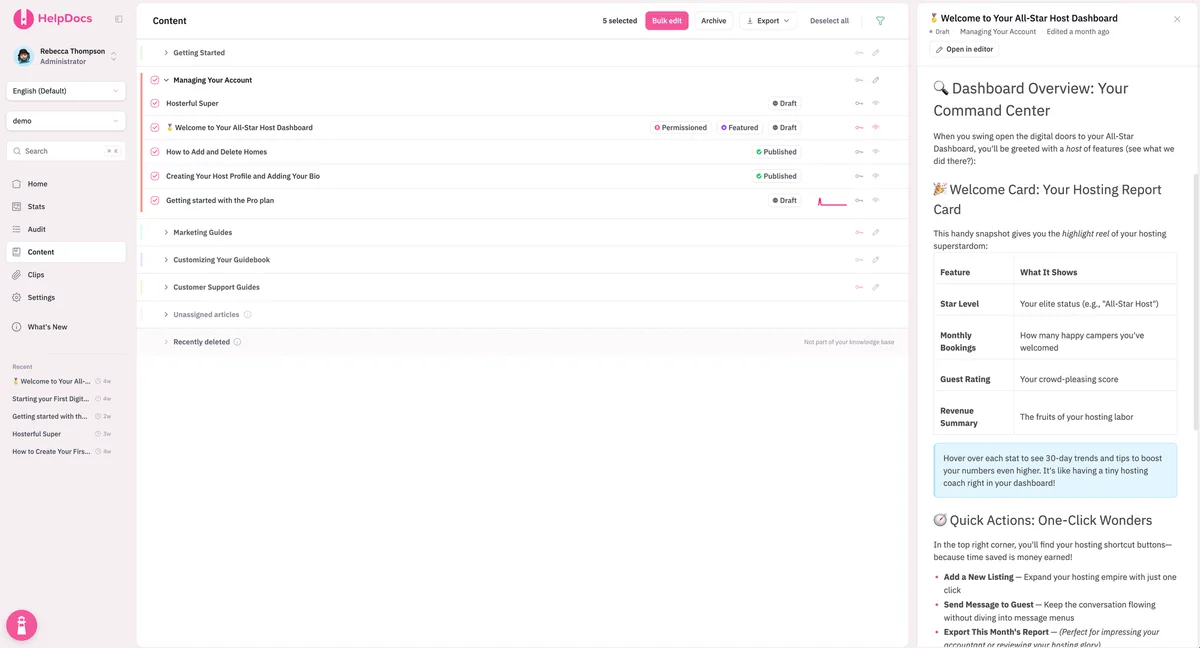
Ownership works best when it maps to expertise. The billing team owns billing articles, the onboarding team owns the getting-started guides, and so on. That way the person responsible for the content is also the person most likely to notice the moment it goes stale. HelpDocs makes this concrete with user roles and permissions, so each owner can edit their own area without stepping on anyone else’s.
How often should you review knowledge base content?
Set a review cadence and stick to it. A quarterly pass over your top articles catches most drift before customers do, and your highest-traffic pages may deserve a monthly look. The exact interval matters less than the fact that it’s scheduled rather than heroic.
Tie reviews to triggers, too. Every product release, pricing change, or policy update should kick off a quick “what did this just make wrong?” sweep. For the full mechanics of audits, content retirement, and version control, see knowledge base maintenance, which is the deep dive on keeping content fresh.
Build feedback loops into every article
Your customers will tell you what’s broken if you let them. A simple “was this helpful?” thumbs up or down on each article turns every reader into a quality checker. A run of thumbs-down is a flare telling you exactly which article to fix next.
Close the loop internally as well. Give your support agents a one-click way to flag an article that let a customer down, because they’re the first to spot the gaps. The strongest knowledge management best practices treat feedback as a constant signal, not an annual survey.
Measure what people actually use
You can’t improve a knowledge base you’re not watching. A few metrics tell you most of the story:
- Searches that return nothing. Empty search results are a content wishlist your customers wrote for you.
- Top and bottom articles by views. See what’s carrying the load and what’s dead weight.
- Deflection rate. How many would-be tickets your content resolved before they reached a human.
- Helpfulness ratings. The thumbs data, read per article.
The point of measuring isn’t a tidy dashboard. It’s a to-do list. Tools like HelpDocs’ optimization features surface failed searches and weak articles so you write based on evidence instead of guesswork.
This matters because findability is where most self-service quietly fails. Customers routinely give up not because the answer is missing but because they can’t find it. The articles often exist. People just can’t reach them.
Capture the knowledge stuck in people’s heads
The most valuable knowledge in your company is usually the least written down. It’s the workaround a senior agent knows by heart, the “oh, you just have to…” that never made it into a doc. This is tacit knowledge, and it walks out the door every time someone leaves.
Make capturing it routine. Turn recurring ticket answers into articles, run short brain-dump sessions before a teammate changes roles, and praise people for documenting rather than hoarding. Every answer that lives only in one person’s memory is a single point of failure. That gets expensive at scale, where McKinsey estimated knowledge workers spend around 20% of their day just searching for and gathering information.
Keep content findable as it grows
A knowledge base that was easy to navigate at 30 articles can become a maze at 300. Findability is a practice, not a one-time setup. Keep titles written in your customers’ words, prune duplicates before they multiply, and revisit your categories as the library grows.
Search deserves special care, because it’s how most people arrive. Watch which queries come back empty, then either write the missing article or re-title an existing one to match the words people actually use. A findable answer beats a beautifully written one that nobody can locate.
Knowledge management best practices at a glance
Here’s the whole set in one place, with the payoff each one buys you.
| Best practice | Why it pays off |
|---|---|
| Single source of truth | Everyone reads the same, current answer |
| Named owners | Content stays accurate because someone’s accountable |
| Scheduled review cadence | Drift gets caught before customers do |
| Feedback loops | Readers and agents flag what to fix next |
| Usage measurement | You write based on evidence, not guesswork |
| Capturing tacit knowledge | Expertise survives staff changes |
| Ongoing findability | Answers stay reachable as the library grows |
The bottom line
A great knowledge base isn’t a project you finish. It’s a living thing you tend, and these best practices are how you tend it without it eating your week. Name owners, review on a schedule, listen to your data, and keep pulling knowledge out of people’s heads and into articles people can find.
Do that, and the help center you launched keeps getting more useful every month instead of slowly falling apart. If you want the bigger-picture playbook behind all this, what is knowledge management sets the foundation these habits build on.