Internal vs external knowledge bases
Decide what belongs in a public help center versus a private team space.
You’ve just published a crisp article on resetting a password, and it’s already saving your team a dozen tickets a day. Then a new hire asks where the refund policy lives, and you catch yourself: that answer really shouldn’t sit on the same public page. Some of what you know is meant for the whole world, and some of it is strictly for the people you work with.
That divide is the whole point of an internal vs external knowledge base. One is a public help center your customers read on their own; the other is a private space where your team finds the answers it needs to do the job. Deciding what goes where is really a question of how you structure a knowledge base around who’s actually reading it, and getting it right keeps sensitive stuff private and customer answers easy to find.
The two often share content, and plenty of teams keep both. Let’s sort out what belongs in each, how access differs, and when running a pair makes sense.
What’s the difference between an internal and external knowledge base?
An external knowledge base (you’ll also hear it called a public help center) is the self-serve library your customers use to answer their own questions. Anyone can reach it, usually through search or a help link, and it’s written for people who don’t work at your company.
An internal knowledge base is the private version for employees. It holds the processes, policies, and context your team relies on, and it sits behind a login so only staff can see it. Same core idea, a searchable set of articles, but a different audience and different rules about who gets in.
What belongs in an external knowledge base
External content answers the questions customers ask over and over. Think getting-started guides, feature how-tos, troubleshooting steps, billing FAQs, and the occasional “why is this setting doing that” explainer. The tone is friendly and jargon-free, and it assumes the reader has zero inside knowledge of your company.
This is the content that quietly does your support team a favor. Harvard Business Review found that 81% of customers try to resolve an issue on their own before reaching out to a live agent (Harvard Business Review). A public help center is what catches all that traffic, and it’s distinct from the ticketing tool that handles the leftovers, a difference we untangle in knowledge base vs help desk.
A good rule for external articles: write them as if the reader has never spoken to you and never will. No internal codenames, no “ask Dave in ops,” no half-finished notes.
What belongs in an internal knowledge base
Internal content is the stuff that keeps your team rowing in the same direction. Standard operating procedures, escalation paths, refund and discount rules, onboarding checklists, engineering runbooks, and the answers to “how do we actually handle this?” all live here. It’s fine to be more technical, because your audience already speaks the language.
This is also where the cost of not having a knowledge base shows up. McKinsey found that employees spend an average of 1.8 hours every day, or 9.3 hours a week, searching for and gathering information (McKinsey). And Gartner reports that 47% of digital workers struggle to find the information they need to do their jobs (Gartner). A well-kept internal knowledge base is how you claw that time back, and it’s a cornerstone of good knowledge management.
Internal vs external knowledge base: the key differences
Here they are side by side, which is probably the comparison that brought you here.
| Internal knowledge base | External knowledge base | |
|---|---|---|
| Audience | Employees and teammates | Customers and prospects |
| Access | Private, login required | Public, open to anyone |
| Content | SOPs, policies, runbooks, onboarding | How-tos, FAQs, troubleshooting |
| Tone | Direct, can use internal jargon | Friendly, plain, assumes no context |
| Tooling | Permissions, roles, SSO, audit trails | Search, SEO, branding, feedback widgets |
The cleanest way to hold the difference in your head: an external knowledge base is written to be found by strangers, and an internal one is written to be found by colleagues. Everything else follows from that single question of who’s reading.
How does access control differ?
External access is the easy part: there mostly isn’t any. The whole value of a public help center is that customers can land on it without a password, so you optimize for search and discoverability, not gatekeeping.
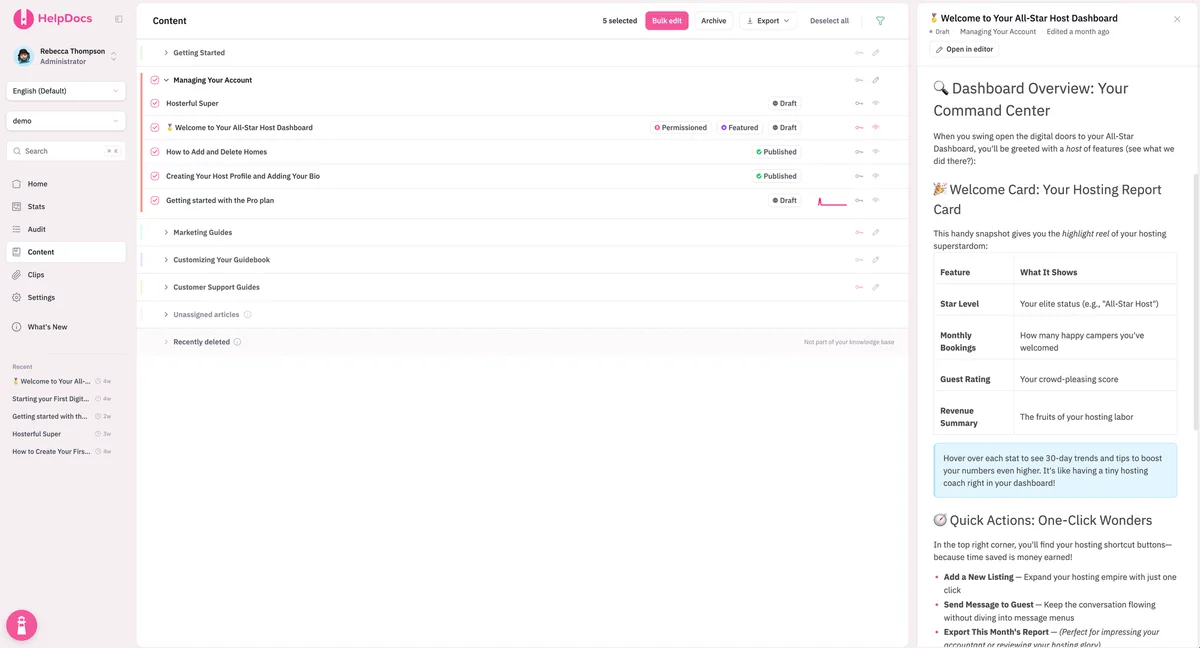
Internal access is where the real work happens. You’ll want logins tied to your team’s identity provider (SSO), roles that decide who can read versus edit, and ideally an audit trail so you know who changed what. Some internal bases go a step further with per-category permissions, so the finance runbook isn’t visible to the whole company. HelpDocs supports private, access-controlled knowledge bases alongside public ones, so a single platform can cover both jobs.
When should you run both?
Most growing companies land here, and for good reason. An external knowledge base deflects the repetitive customer questions, while an internal one keeps your team consistent on the answers customers never see. They solve different problems, so one rarely removes the need for the other.
There’s a nice feedback loop between them, too. Your support team leans on internal SOPs to answer tickets, and the best of those answers get rewritten in plain language and promoted to the public help center. Since so many self-service attempts stall before they fully resolve, that pipeline from internal notes to public articles is how you close the gap over time.
You don’t have to launch both on day one. Start with whichever pain is louder. If customers keep asking the same things, build the external base first. If your team keeps reinventing answers or losing them in chat, start internal.
The bottom line
An external knowledge base publishes answers to your customers, and an internal one keeps answers within reach of your team. The split comes down to audience: public, plain-spoken, and open on one side; private, detailed, and access-controlled on the other.
Decide where each article belongs before you write it, lock down access on the internal side, and let your best internal answers graduate into public ones. Do that and both halves get stronger, while nothing sensitive ever ends up on a page it shouldn’t.