Documentation software
The editor and workflow features that keep docs accurate over time.
You find the perfect help article, follow it step by step, and it’s wrong. The screenshot shows a button that moved three releases ago, and the “final” step points at a setting that no longer exists. That’s rarely a writing problem. It’s a tooling problem, because the software your team writes in quietly decides whether your docs stay right or slowly rot.
Documentation software is the platform you use to write, publish, and maintain that content, whether it’s a customer-facing knowledge base, an internal wiki, or your API reference. Good tools do far more than store text. They give you the editor and the workflow to keep content accurate as your product changes underneath it. If you’re setting things up for the first time, our guide on how to build a knowledge base walks the whole path, and if you want a refresher on the different flavours of docs, start with what documentation actually is.
This article is the other half of that story: not how to start, but which features keep a knowledge base healthy once it’s live.
What is documentation software?
At its simplest, documentation software is a knowledge base platform with an editor attached. You write articles in it, organize them, publish them to a help center, and (crucially) come back to fix them later. Some teams cobble this together from a shared drive and a folder of Google Docs, which works right up until three people edit the same file, nobody knows which version is live, and a customer follows the stale one.
Dedicated tools exist to close that gap. The category overlaps heavily with knowledge base software, and for most support and product teams the two are the same purchase. The distinction that matters isn’t the label. It’s whether the tool actively helps you keep content correct, or just gives you somewhere to dump it.
The documentation software features that matter
Every vendor’s marketing page lists the same twenty features. Only a handful actually move the needle on accuracy, so those are the ones worth pressure-testing in a trial.
Authoring and editing
This is where your team lives, so it has to feel effortless. Look for a clean editor that handles the basics without fuss: headings, images, callouts, tables, and code blocks. Reusable snippets and templates matter more than they sound, because a shared help article template is what stops ten authors producing ten different-looking articles. The less friction there is between “I know the answer” and “it’s written down,” the more your knowledge base actually grows.
Versioning and revision history
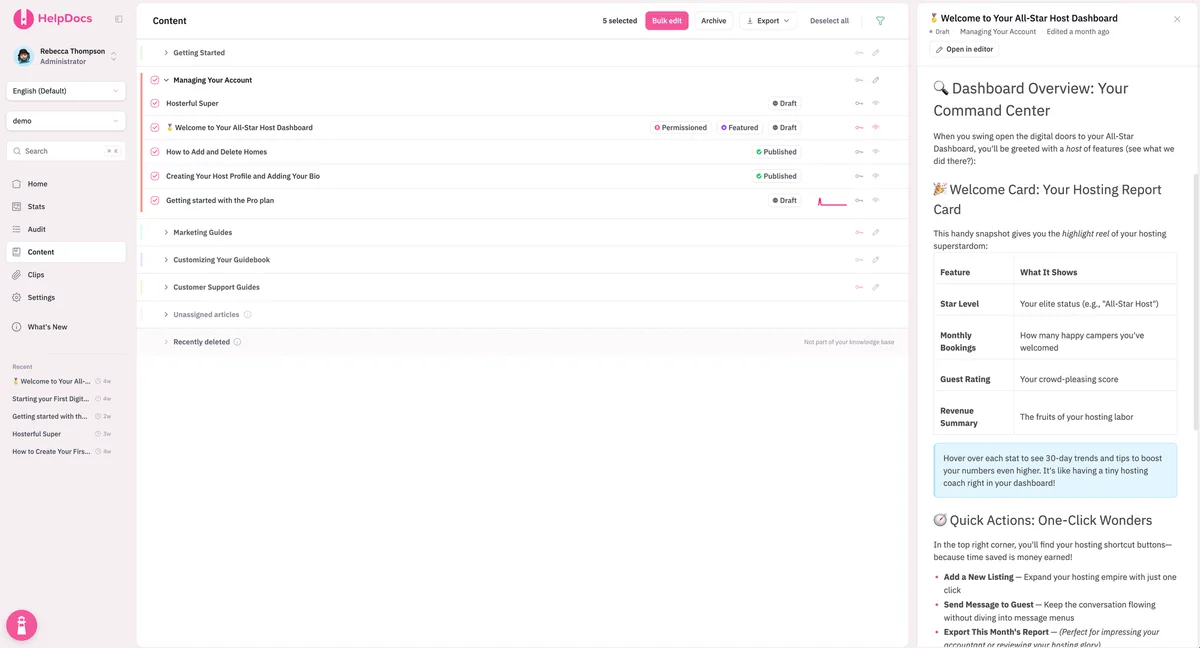
Accuracy over time is really a versioning problem. When every edit is tracked, you can see who changed what, compare an article to last month’s version, and roll back a bad edit in seconds. This is the single feature that separates real documentation software from a glorified text box. Without it, an article is only ever as trustworthy as the last person who touched it.
Review and approval workflows
Docs drift because nobody owns keeping them fresh. Review workflows fix that by building the habit into the tool: assign an owner, set a review date, and route changes through an approver before they go live. That’s how a support team keeps a busy help center accurate without turning it into a full-time job. It also keeps sensitive or regulated content from being published on a whim.
Search that works
Content nobody can find might as well not exist, and a big share of failed self-service comes down to customers simply not finding the right article. Good documentation software treats search as a first-class feature, with typo tolerance, synonyms, and analytics on what people typed. Those failed-search logs are also the best to-do list you’ll ever get for what to write next.
Permissions and access control
Not everyone should be able to edit everything, and not every article should be public. Role-based permissions let you separate authors from approvers, keep drafts private until they’re ready, and run an internal wiki alongside your public help center from the same tool. This is where the line between an internal and external knowledge base gets drawn in practice.
Analytics and reporting
You can’t improve docs you’re not watching. Article-level analytics tell you what’s viewed, what’s rated helpful, and where readers give up. This closes the loop: search logs and thumbs-down ratings point at the weak spots, and you fix the content before it costs you a ticket. Internally, this is time well spent, since McKinsey found employees spend around 1.8 hours a day just hunting for information (McKinsey). Good docs, easily found, win some of those hours back.
Here’s the shortlist to run against any tool you’re evaluating, and why each one earns its place.
| Feature | What it does | Why it matters |
|---|---|---|
| Authoring and editing | A clean editor with snippets and templates | Low friction means more docs actually get written |
| Versioning and history | Tracks every change, lets you roll back | Keeps articles trustworthy as your product shifts |
| Review workflows | Owners, review dates, approvals | Builds the habit of keeping content fresh |
| Search | Typo tolerance, synonyms, search logs | Content nobody can find might as well not exist |
| Permissions | Role-based access, private drafts | Runs internal and public docs safely side by side |
| Analytics | Views, ratings, drop-off, empty searches | Shows you exactly what to fix next |
| Publishing | Custom domain, branding, responsive design | A help center that feels like part of your product |
| Integrations | Chat, ticketing, AI assistants | Puts answers where customers already are |
Documentation software for different kinds of docs
The core features stay the same, but the emphasis shifts with the audience. Technical documentation leans hard on code blocks, API references, and version tags. IT documentation cares more about access control, audit trails, and keeping runbooks locked down. Process documentation is all about step-by-step workflows and clear ownership. Pick the tool whose defaults match the docs you write most, rather than the one with the longest feature list.
The bottom line
The features that matter in documentation software all point at one goal: keeping your knowledge base accurate long after launch day. Versioning protects you from bad edits, review workflows fight staleness, search and analytics tell you what’s broken, and permissions keep the whole thing safe to run at scale. Nail those and your docs stay a genuine self-service support engine, not a graveyard of half-true articles.
When you’re ready to see it in practice, you can create your knowledge base and put these features to work, then use the ways to optimize it to keep deflection climbing as you grow.