Customer support automation, without the overclaiming
Customer support automation is using software to resolve or route customer questions without a person handling each one. It covers four distinct jobs: deflecting a question before it becomes a ticket, answering it in plain language from your published documentation, drafting a reply for an agent to approve, and routing whatever is left to the right queue. Three of those four are answered from your own content, which is why the quality of your documentation sets the ceiling.
Support automation has a credibility problem, and it’s self-inflicted. A decade of chatbots that couldn’t answer anything trained customers to look for the “talk to a human” button before reading a single word.
The technology genuinely changed. What hasn’t changed is that automation only works on questions somebody already answered somewhere, which makes this a documentation project with an automation layer on top. Here’s what’s actually automatable, what isn’t, and the order to do it in.
What is customer support automation?
Customer support automation is using software to resolve or route customer questions without a person handling each one. In practice it covers four different jobs that get sold as one:
| The job | What it does | Where the answer comes from |
|---|---|---|
| Deflection | Stops the question becoming a ticket | Your documentation |
| Answering | Replies in plain language, cites the source | Your documentation |
| Assisting | Drafts a reply for an agent to approve | Your documentation, plus ticket history |
| Routing | Sends the ticket to the right queue | Your help desk’s rules |
Three of those four run on your documentation. That’s the part worth internalising before you shop for anything: the automation is not the hard bit.
Why the ceiling is your content
Salesforce found that AI resolved 30% of service cases in 2025 and expects that to reach 50% by 2027 (Salesforce). Gartner predicts agentic AI will autonomously resolve 80% of common customer service issues without human intervention by 2029 (Gartner).
Those forecasts assume the answers exist and are correct. Today only 14% of customer service issues are fully resolved in self-service, and 43% of customers couldn’t find content relevant to their issue (Gartner).
Automating on top of thin documentation doesn’t produce fewer tickets. It produces confidently wrong answers, then the same tickets with an annoyed customer attached.
What you can automate today
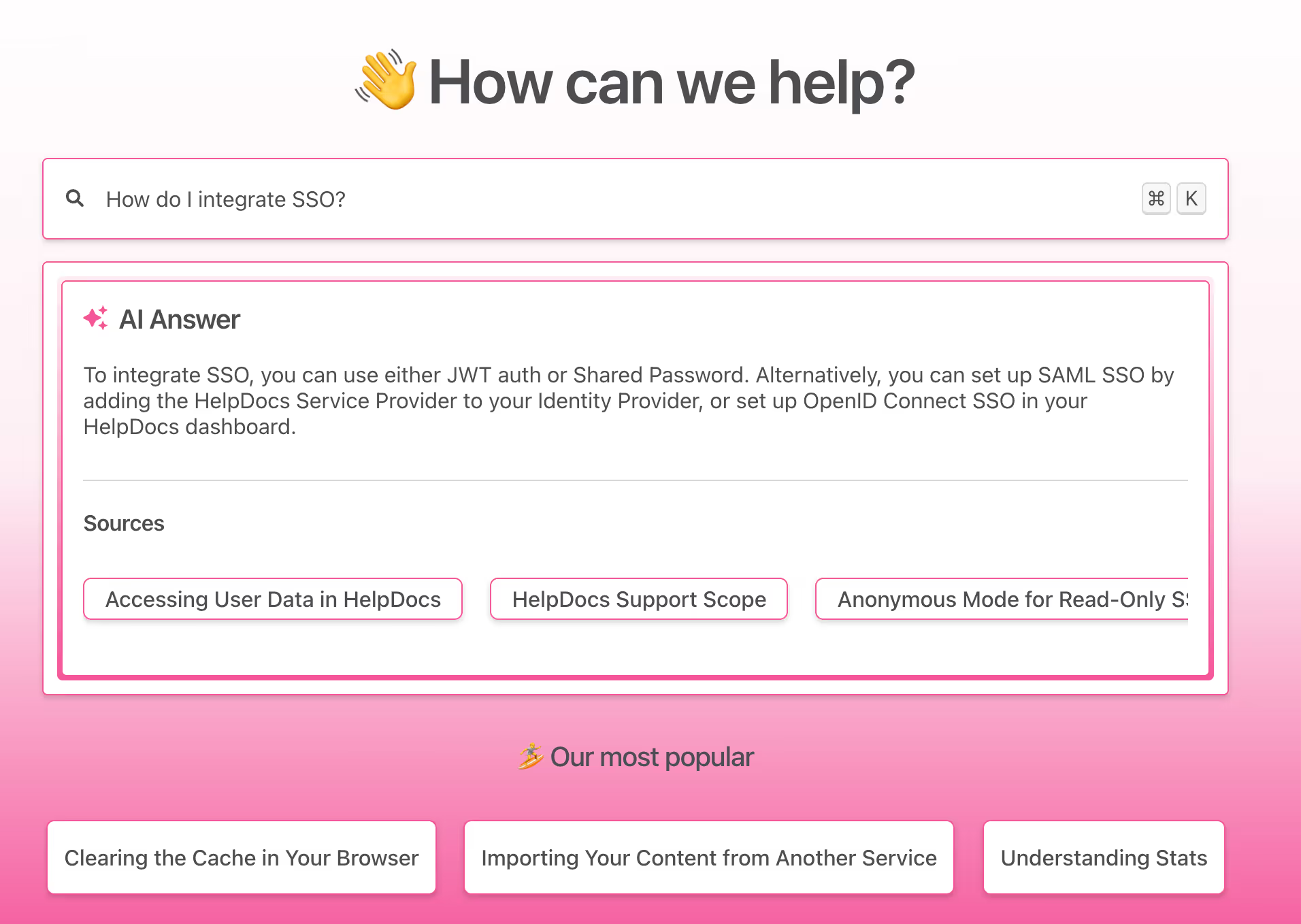
- Answers to repeat questions. The questions at the top of your inbox repeat every month. An AI grounded in your published articles handles those and links the article it used, so the customer can verify it.
- Help at the moment of confusion. Most questions occur mid-task, not on your help center. A widget like Lighthouse answers in the product, which deflects far more than a footer link.
- The metadata nobody writes. Meta descriptions, search tags, alt text, and summaries can be generated in bulk with HelpDocs AI, which makes existing content findable rather than adding more.
- Content maintenance triage. Improve with AI scores an article out of 100 and names the specific edits worth making, so a maintenance backlog becomes a ranked list.
- Answers inside your own stack. The REST API and HelpDocs MCP let assistants and internal tools read your documentation directly. Claude over MCP is the clearest example: it answers from approved docs and cites the source.
What you can’t automate, honestly
- Anything not written down. Retrieval can’t invent your refund window. This is the single biggest limiter and it’s fixed with writing, not with tooling.
- Judgement calls. Refund exceptions, account security, anything with legal or financial consequence. Automate the explanation, not the decision.
- Angry. A frustrated customer on their third contact wants a person, and routing them to a bot is how a solvable problem becomes a churn risk.
- Contradictions. If two articles disagree, automation picks one. Usually the older one.
The order to do this in
The rollout
Step five is the engine, and search analytics is where you read it.
Before you connect anything
Run the audit. Internal or customer-facing, the failure modes are the same: gaps, contradictions, stale pages, text trapped in screenshots, and access rules that let an assistant read something it shouldn’t.
The nine checks in AI knowledge base each come with a way to test them in minutes, and how AI uses your knowledge base explains the retrieval mechanics underneath. If your team’s internal documentation is in scope too, internal knowledge base covers that side, where permissions matter as much as accuracy.
For the tools themselves, best AI knowledge base software compares ten of them on how their AI is grounded, what it costs per answer, and whether you can switch it off. HelpDocs AI covers our side, and pricing has the plans with AI credits spelled out.